
by Brian Miller

Michael Cassius Dean’s 1922 songster The Flying Cloud, published in Virginia, Minnesota in 1922, was the first significant book of songs popular in the lumber camp bunkhouses of the Upper Midwest. Dean himself was unique among most songcatchers in that he himself was a former lumberjack and a singer in the tradition he documented. In fact, a year after publishing The Flying Cloud, Dean played the role of source singer for collector Franz Rickaby who transcribed 27 of his songs and recorded background information supplied by Dean. We now know that Dean also met collector Robert Winslow Gordon who recorded Dean singing fragments of 33 songs in 1924.
I am interested in Dean because he was a Minnesotan and also because his life, repertoire and singing style exemplify the strong Irish influence in the “woods singing tradition” once common throughout the white pine belt stretching from the Canadian Maritimes to Minnesota. The Dean book, Rickaby transcriptions and Gordon recordings combine to give us an unusually full picture of Dean’s songs and singing. I have spent the last decade filling out the details of his life through census documents, newspapers and letters.
Michael Cassius Dean’s parents were from County Mayo, Ireland. Dean was born in 1858 near Canton, New York in the northern Adirondacks, the eighth of nine children. He learned at least three of his songs, “The Lady Leroy,” “Young Charlotte” and “Caroline of Edinburg Town” from his Irish mother who, he told Rickaby, sang such tragic ballads as lullabies. When asked about “The Lady Leroy,” Dean said that “all his folks sang it” so perhaps there were other singers in his family as well. By the age of 15, Dean was spending time in northern New York logging camps. He later recalled that the loggers he met there were “mainly French-Canadian” though the only singer he mentioned to Rickaby from this time period was the (presumably Irish) Barney Murphy.
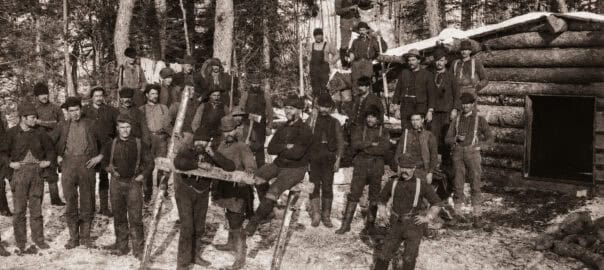
In the late 1870s, around the time of his 20th birthday, Dean followed the logging industry westward to Michigan where he worked as a lumberjack, likely in the Manistee area, for several years. From Michigan, he continued westward to Pine County, Minnesota where he arrived around 1885 and, his obituary says, “worked in the woods and saw mills of Hinckley.” The 1885 Minnesota Territorial Census lists 28-year-old “Michael McDone” as a boarder at Hinckley’s Morrison Hotel, an establishment frequented by lumbermen and run by Scottish/Nova Scotian immigrant John Morrison and his Irish immigrant wife, Mary.
In Hinckley, Dean found himself among many first and second generation Irish-American businessmen with ties to logging, railroads and saloons. These included Thomas Brennan whose lumber mill was Hinckley’s chief employer and Thomas’s brother James who was a saloon owner and first president of incorporated Hinckley. The Brennans grew up in the same small town in County Kilkenny as the influential Bishop John Ireland of St. Paul. William O’Brien operated logging camps on the nearby Kettle River and would go on to be one of Minnesota’s most successful lumber barons with a mansion on Summit Avenue next to the governor’s mansion. Today a state park is named for him.


Dean, soon after arriving in Hinckley, stopped doing woods work and began a thirty year career working in north woods saloons and hotels. From 1885 to 1915, Dean tended bar for at least 14 different establishments, some of which he owned himself, including places in Hinckley, Sandstone, Willow River, Pine City, Moose Lake, St. Paul and Superior, Wisconsin.
Folklorist Robert Bethke who worked with lumbermen in Dean’s native New York state, notes that north woods barrooms often acted as an extension of lumber camp bunkhouse singing culture. It is likely that thirsty woodsmen, and Dean himself, sang in at least some of his establishments. Dean’s saloons and hotels catered to lumberjacks that poured into these towns at Christmas and in the spring when released from their alcohol-free, live-in lumber camps. Things sometimes got out of hand to the point that Dean kept a revolver behind the bar and used it more than once to restore order. Dean was also well-loved for his wit and hospitality and is frequently referred to as a “genial landlord” in Pine County newspapers.
Though he never strayed far from the saloon business during these years, Dean did try his hand at farming as well. The Dean farmhouse east of Hinckley played host to midwinter parties such as this one described in the Hinckley Enterprise:
The surprise party last week at M. C. Dean’s, was a most enjoyable event. Three sled loads drove out to his farmhouse, and by the way he has one of the most convenient and finely appointed farmhouses in this section, reaching there at 8:30. The kitchen was cleared, the fiddle started and from then on feet were tripping the light fantastic in a very fantastic manner. The more staid, stayed upstairs and tried conclusions at the card tables, some to their sorrows. About midnight the tables were set and all enjoyed themselves to the utmost, feasting on the good things set forth. The party broke up and all returned to town in the small hours of the morning. All appreciated the kindly attentions shown and pronounce M. C. Dean’s the place to go for a good time.
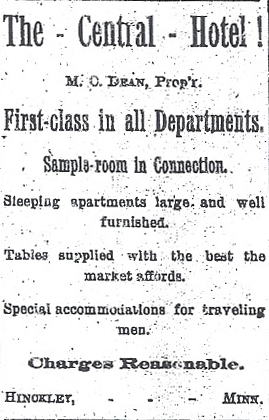
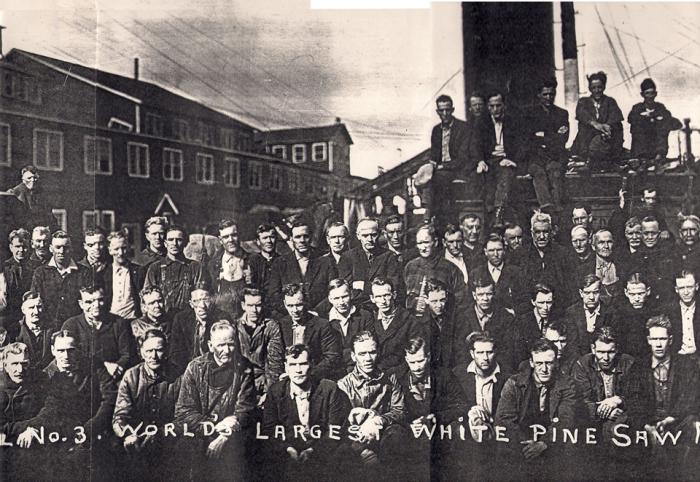
Around 1914, Dean retired from bartending and worked briefly on the Allouez ore docks in Superior, Wisconsin. Saloon keeping was becoming less viable as prohibition pressure and laws swept over Minnesota in the 1910s. Pine County voted itself dry in 1915. From the ore docks, Dean moved to Virginia, Minnesota where he took a job as night watchman for the Virginia and Rainy Lake Lumber Company’s enormous white pine lumber plant – the largest in the world at the time. He lived in the Pine Tree Inn, a boarding house across the street from the mill’s gate. After settling in at the Pine Tree Inn, in 1920, at the age of 62, Dean made his first visit in 31 years to his family back in Canton, New York.
Perhaps this trip, combined with his return to outdoor laboring jobs at the ore docks and lumber mill, sparked a renewed interest in old songs. By 1922, Dean was writing in to the “Old Songs That Men Have Sung” column that ran in the pulp magazine Adventure asking for words to old sea songs he half remembered. He must have been at work before that at solidifying his repertoire before as that was the same year The Flying Cloud was published. Dean sent a copy of the new book to “Old Songs” editor Robert Frothingham with the following note:
I am sending you under separate cover a collection of old time songs that I have gathered up in my wandering around on the Lakes and in Lumber Camps and Rail Road Construction works there is not a song in the whole Book but what I have memorized and can repeat over=I will not say sing for I am not verry musical although I sing some times for my own amusement. People say I am easly amused.
The songster’s cover title gives an indication of the prominence of Irish songs in Dean’s repertoire: The Flying Cloud and 150 Other Old Time Poems and Ballads: A Collection of Old Irish Songs, Songs of the Sea and Great Lakes, The Big Pine Woods, The Prize Ring and Others.
The Flying Cloud contains 166 texts. About 100 contain Irish names or place names. Of those 100, about half are Irish street songs and half are Irish music hall songs – mainly from the American stage of the late 1800s. The street songs include songs of unrequited love, songs of Irish soldiers, Irish sailors, Irish patriots, Irish boxers, immigrant laments and several North American compositions about Irish railroad workers and other Irish laborers. Dean’s Irish music hall songs include compositions by Edward Harrigan, Joseph Skelly, Pat Rooney and several others. There are comic songs, sentimental songs longing for “The Land Where the Shamrocks Grow,” and songs of Irish-American political aspiration such as “Nothing’s Too Good for the Irish.” The remainder of the collection includes many minstrel and parlor songs, a few interesting popular songs about poor houses and poems on either side of the prohibition debate.
Interestingly, only five songs out of 166 are specifically about the experience of logging. When, years later, folklorist D.K. Wilgus declared Dean’s songster to be “a slice of the repertoire of the Northern folksinger” he was acknowledging the fact that lumber camp singing was only very seldom about lumbering.
It was likely the publication of The Flying Cloud that brought Dean to the attention of Grand Forks-based collector Franz Rickaby who visited Dean at the Pine Tree Inn in the summer of 1923. Rickaby called Dean “an indefatigable dispenser of good fellowship” and considered him among the class of woods singers possessing “the gifts of a naturally good voice, a particularly retentive memory, and an inherent inclination to sing.”
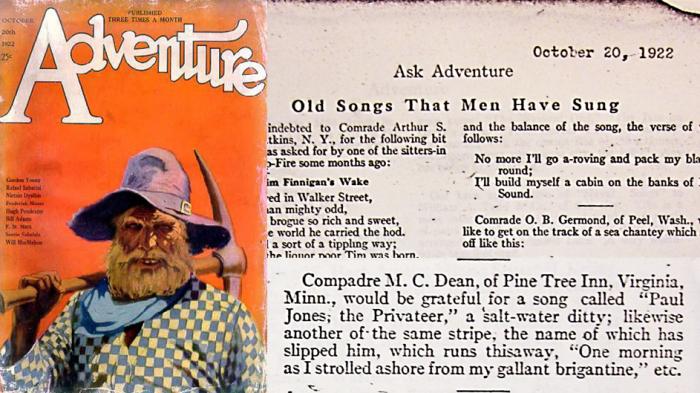
Meanwhile, Dean’s letters to “Old Songs That Men Have Sung” connected him to a network of other old tradition bearers (and the editors of the column itself) who corresponded with him, swapped songs and purchased copies of The Flying Cloud by mail order (for 75 cents). These relationships led to “Old Songs” editor Robert Winslow Gordon tracking Dean down at his sister’s house back in Canton, NY where, the local newspaper reported, “M.C. Dean…, who has a fine rich voice sung into the recording machine during the entire day.”
The Gordon recordings reveal Dean’s singing style to exhibit many characteristics of Irish traditional singing. He sings with a leisurely pace, often drawing out particular words for emphasis. Dean’s ornamentation is relatively subtle but he makes use of many grace notes and occasional melismatic flourishes. His tone is resonant and clear and he, like many Irish singers, often closes to a sustained sung “n” or “m” at the end of words. Though he was born in New York state, he also seems to have a bit of an Irish accent.
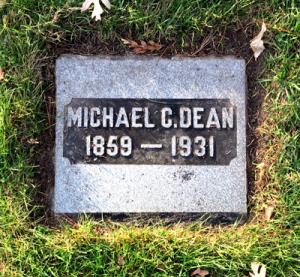
Michael Dean continued to correspond with other traditional singers by mail and to learn additional songs through his 70th birthday in 1928. By that time, academic collections of folk songs such as William R. MacKenzie’s Ballads and Sea Songs from Nova Scotia were citing The Flying Cloud as proof that a song was “found in Minnesota.” In August 1931, at the age of 72, Dean left the Virginia and Rainy Lake lumber mill and took a job as a laborer for St. Louis County. He was struck by a car and killed his first Monday on the job.
This article first appeared in the Celtic Junction Arts Review, Issue 2, Samhain 2017