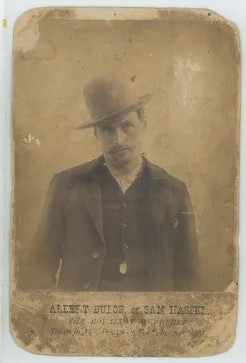
Albert Bulow
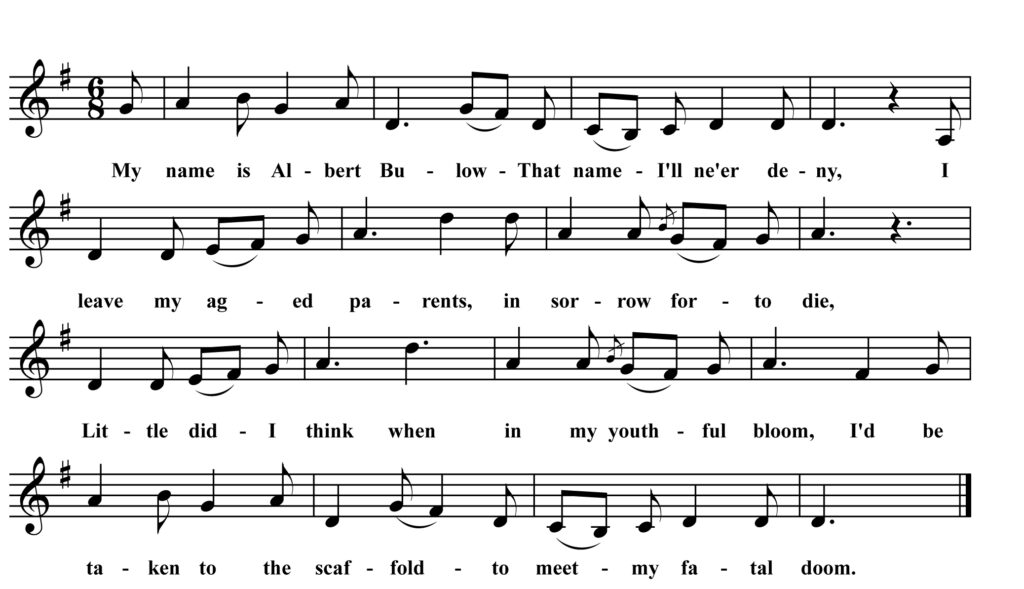
My name is Albert Bulow, that name I’ll never deny,
I leave my aged parents in sorrow for to die,
Little did I think, when in my youthful bloom,
I’d be taken to the scaffold, to meet my fatal doom.
Come, all you tender Christians, where ever you may be,
And likewise pay attention to these few lines you see,
For the murder of Franklin Eich, I am condemned to die,
On the nineteenth day of July, upon the scaffold high. Cho.
It was in the city of Verndale I tried to make escape,
But Providence being against me, it proved to be too late,
They took me to the prison, all in my youthful bloom.
And now to the scaffold I must go to meet my fatal doom. Cho.
A mob thought to lynch me but the sheriff was warned in time,
And with Randall and their victim to Brainerd he did flee,
We left the angry mob all in their wrought up glee,
To leave the court of mercy deal justice unto me. Cho.
My friends came to see me and bid their last adieu,
They spoke their words of kindness and wept most bitterly.
And said to me, dear Albert, to-day you’ve got to die,
For the murder of Franklin Eich, upon the scaffold high. Cho.
Come, all young men, a warning take from me,
And leave a wild and sporting life; it leads to misery,
Bad company first, then liquor came in time;
It brought me down to the lowest, and to this awful crime. Cho.
It is sad, my friend, to leave you and bid you all good-bye,
But Fate is all against me and I am doomed to die,
That justice has been dealt to me, I’m not prepared to tell,
But God will treat me justly, he doeth all things well.
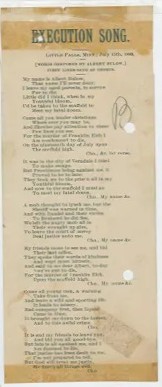
We start this year with a rare ballad that was actually printed as a broadside here in Minnesota in 1889. If newspaper accounts are true, it is also an example of a “gallows ballad” actually composed by the condemned criminal himself. The Morrison County Historical Society has an original broadside the heading of which reads:
EXECUTION SONG.
LITTLE FALLS, MINN. JULY 15, 1889
[WORDS COMPOSED BY ALBERT BULOW]
FIRST LINES SUNG AS CHORUS
The murder of well-to-do farmer Franklin Eich outside of Royalton, Minnesota in October 1888 and the subsequent apprehension, trial and hanging of Albert Bulow was followed closely in the Little Falls newspapers as well as papers in the Twin Cities. Bulow was hanged for his crime in Little Falls at 1:52AM on July 19, 1889.
The Minneapolis Journal on July 18th wrote:
Bulow, in order to beguile the tedious hours of waiting until death shall set him free, has composed a little song which he calls his death song. There is not much poetry in the piece and Bulow does not pretend that he has made much of a success of his poem but he has had it printed all the same and has been selling copies of it at 5 cents a copy. What Bulow proposes to do with the money he has raised in this peculiar way he does not say. It is all the money he has.
The St. Paul Daily Globe on July 19th reported that Bulow possessed “the German love of music” and that the jailer’s wife organized a quartet for the prisoner in which “Bulow’s voice was never below the others.” The same article reports that:
A few days ago, with the assistance of his night watch, he ground out a poem on himself, which was printed and sold to curious visitors at 15 cents per copy.
Bulow’s song, in typical folk song fashion, was clearly modeled on the earlier American-made gallows ballad “James Rogers” (Rodgers was executed in 1858). I matched the Bulow text to the melody song for the James Rogers song by Minnesota singer Mike Dean (which I shared in the June 2023 Northwoods Songs).