03 Jun

Bold Daniel [Laws K34]
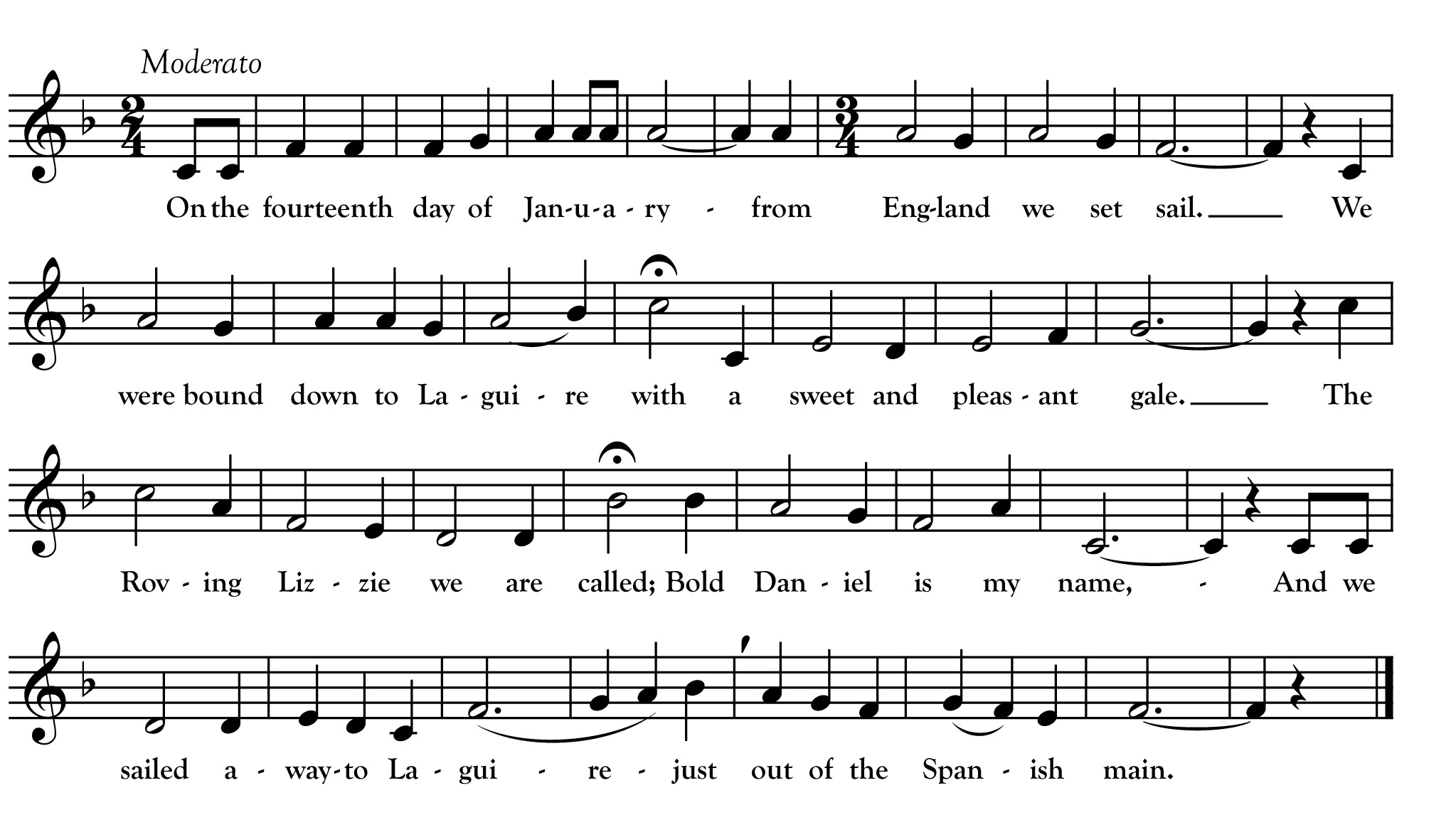
Bold Daniel_Gordon

It was on the fourteenth day of January,
From England we set sail,
We were bound down to Laguire,
With a sweet and pleasant gale;
The Roving Lizzie we are called,
Bold Daniel is my name,
And we sailed away from Laguire,
Just out of the Spanish Main.

And when we reached Laguire,
Our orders did read so,
“When you discharge your cargo,
It’s sail for Callao,”
Our Captain called all hands right aft,
And unto us did say,
“Here is money for you today, my lads,
For tomorrow we’ll sail away.”

It was early the next morning,
As daylight did draw nigh,
The man from at the masthead
A strange sail did espy;
With a black flag under her mizzen peak,
Came bearing down that way;
“I’ll be bound she is some pirate,”
Bold Daniel he did say.

In the course of three or four hours,
This pirate ranged alongside,
And with a speaking trumpet,
“Where are you from?” he cries.
“The Roving Lizzie we are called,
Bold Daniel is my name,
And we sailed away from Laguire,
Just out of the Spanish Main.”

“Come, back your topsails to your mast,
And heave your ship under my lee.”
“Oh, no! oh, no!” cried Daniel,
I’d rather sink at sea.”
They hoisted up their bloody flag,
Our hearts to terrify.
With their big guns to our small arms,
At us they did let fly.

We mounted four six-pounders
To fight a hundred men,
And when the action did begin,
It was just about half-past ten;
We mounted four six-pounders,
Our crew being twenty-two;
In the course of an hour and a quarter,
Those pirates we did subdue.

And now our prize we’ve taken
Unto Columbia’s shore,
To that dear old place in America,
They call sweet Baltimore;
We’ll drink success to Daniel,
Likewise his gallant crew,
That fought and beat that Pirate
With his noble twenty-two.

————————————————————————————————-

We’re back to the repertoire of Minnesota singer Michael Cassius Dean (1857-1931) this week with a song about piracy. The “Laguire” mentioned in this song must be La Guaira, the chief port city of Venezuela which was actually sacked by English pirates in 1743. The song is relatively rare in tradition. The other three versions I have found were collected in coastal areas of Maine, Newfoundland and England. Mike Dean sang two other songs about pirates “The Flying Cloud” and “Paul Jones the Privateer” and perhaps was fascinated with the theme after working as a sailor on the Great Lakes himself.

The above transcription is my own made from my digital copy of a recording made of Dean’s singing in September 1924 by folk song collector Robert Winslow Gordon. Gordon recorded Dean singing the first verse only. The full text comes from Dean’s 1922 self-published songster The Flying Cloud.

More about this song at The Traditional Ballad Index

20 Apr

The Smugglers of Buffalo

The Smugglers of Buffalo


It was the 6th of Aperil as I lay on my bed,
And thinking of the sorrows that crowned my aching head.
And surrounded I was by officers, and with them I was forced for to go,
For to serve a long and dreary trip to the jails of Buffalo

Then I’ve done my task and got pardoned and once more I am free
And I went down to Sandusky my true love for to see.
But perhaps, my boys, she will give me the bounce when she does a-come to know
That I led a gang of smugglers to the jails of Buffalo.

Oh this girl she came from Patterson, the truth to you I will tell
She was an only daughter and her parents loved her well
They brought her up in the fear of the Lord but little did she know
That she was married to a smuggler who served time in Buffalo

__________________________________________________________

This month we step away from the songs of Irish-Minnesotan Mike Dean for a visit to one of the most fascinating (and musical) Irish settlements in the Great Lakes region: Beaver Island, Michigan. Situated in the center of the northern end of Lake Michigan, Beaver Island’s stranger-than-fiction history is far too colorful to fully convey in this space. In 1851 it was taken over by self-proclaimed Mormon king James Strang and his followers. In 1856 Strang was assassinated (by Mormons on the island) and a group of Irish fishermen, primarily from County Donegal, quickly drove the remaining Latter Day Saints off the island and established a tight-knit community whose isolation made it one of the last great rural strongholds of Irish folk culture in North America.

I transcribed the above song from a field recording made of Beaver Island singer John W. Green (1871-1964) in 1938 by Ivan Walton and Alan Lomax. John W. Green’s parents were Daniel “White Dan” Green and Bridget O’Donnell, both born on the island of Arranmore, County Donegal. Like many Island men of his generation, John Green was a fisherman by summer and a lumberman by winter who knew well over 100 songs, many learned from his musical family members.

Green was frustrated at the time of the recording that he could only recall three verses to “The Smugglers of Buffalo.” He does not say, on the recording, what contraband might have been smuggled in the song but the fact that the singer’s head is aching might give some indication!

References:

Biographical History of Northern Michigan, 1905.

“Detnews.com | Michigan History.” Accessed March 20, 2013.

“RootsWeb: IRL-ARRANMORE-L [IRL-ARRANMORE-L] Aran/Beaver Is Green.” Accessed March 20, 2013.

Walton, Ivan H, with Joe Grimm; illustrated by Loudon G. Wilson; musical scores by Lee Murdock. Windjammers : Songs of the Great Lakes Sailors. Detroit, MI: Wayne State University Press, 2002.

19 Mar

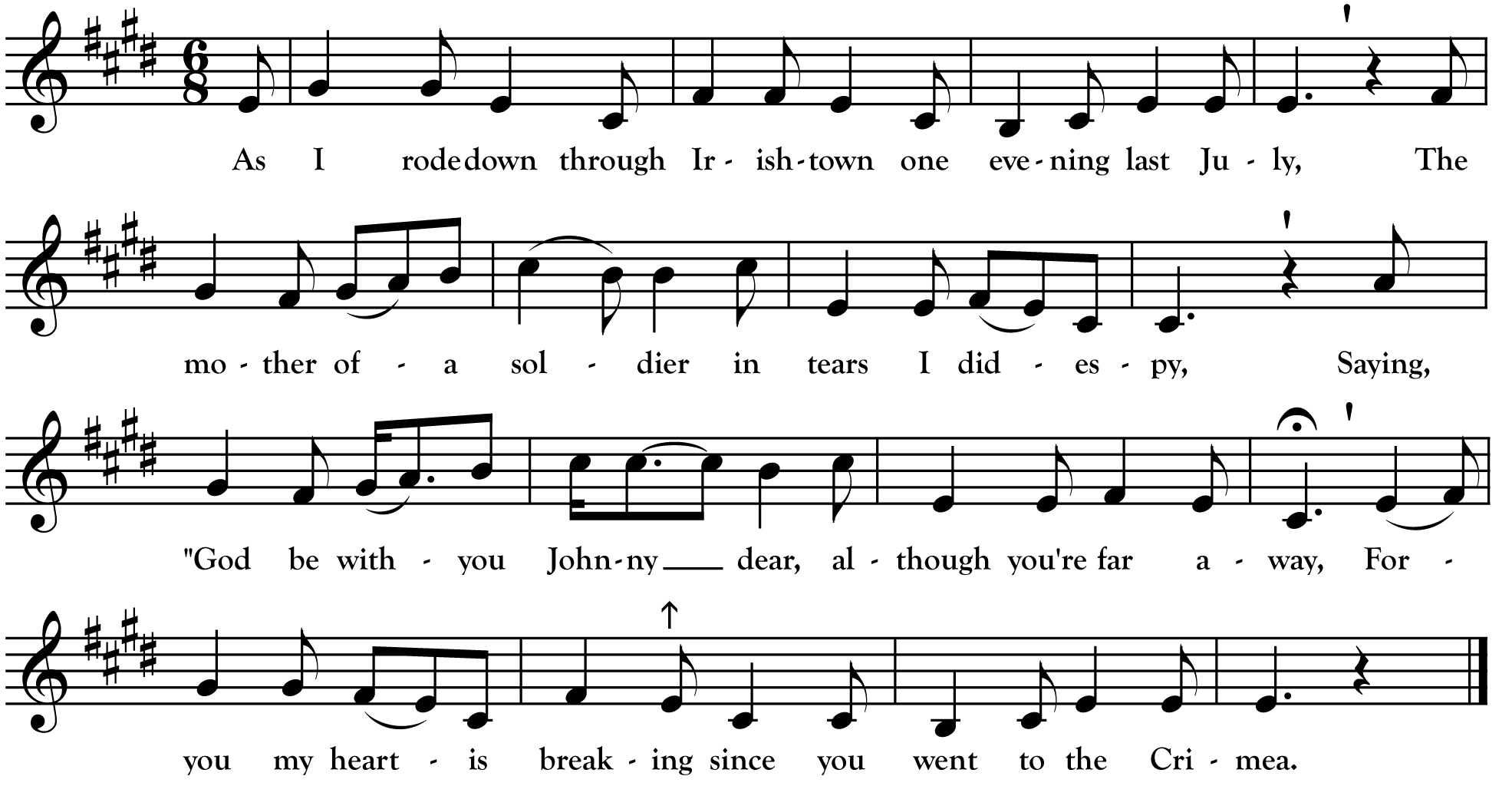
As I Rode Down Through Irishtown [The Crimean War] (Laws J9)

As I Rode Down Through Irishtown

As I rode down through Irishtown one evening last July,
The mother of a soldier in tears I did espy,
Saying, “God be with you, Johnnie dear, although you are far away,
For you my heart is breaking since you went to the Crimea.

“Oh, Johnnie, I gave you schooling, I gave you a trade likewise.
You need not have joined the army if you had taken my advise,
You need not go to face the foe where cannons loud do roar,
Think of the thousands that have fallen now upon that Russian shore.

He joined the Fourteenth regiment, it was a splendid corp,
They landed honorable  mention upon the Russian shore;
He fought in foreign engagements with the loss of men each day,
And there is many a mother shedding tears for sons that are far away,

“You fought at Kurksharosko where you did not succeed,
Likewise at the valley of Inkerman, where thousands there did bleed,
You fought at Balaklava, too it was there you gained the day,
And my darling is a hero although he’s far away.

“It was when we attacked Sebastapool, it was there you’d see some play,
The very ground we stood upon it shook, the truth I say,
The clouds were black with heavy smoke from bomb shells firing there,
And thousands weltering in their blood that went to fight the Bear.

“The English said they would gain the seas whate’er might be their doom,
And thousands there a-falling, cut down in their youthful bloom,
There Paddy’s sons with English guns their valor did display,
And together with the sons of France, thank God, we gained the day.

“Had your heart been made of iron for them you would shed tears,
To see those heroes falling, cut down in their youthful years,
To see those heroes falling and weltering in their gore,
Far from their home and friends, my boys, upon that Russian shore.

“So now to end and finish and to conclude my song,
I thank the God above me for having survived so long,
Likewise my poor old mother, ’twas her I did adore,
And I hope, dear mother, to meet you safe in Garryowne once more.
__________________________________________________________

Every town is an “Irishtown” on St. Patrick’s Day but there are also a few places scattered around the world actually named “Irishtown” including a small town in the Adirondack Mountains of upstate New York. The above version of this song lamenting the sad fate of Irish soldiers in the Crimean War (1853-1856) was sung by Minnesotan Mike Dean (1857-1931) who was born just north of the Adirondacks. “Irishtown” could refer to the Adirondack town, or it could be a simple reference to an Irish neighborhood somewhere else. Versions collected in Ontario and Michigan say “Irish town.”

Dean’s melody is a nicely turned version of the usual one for this song in tradition and it is a well-travelled air associated with many traditional songs including the Scottish “Tramps and Hawkers.”  It was also used by song-maker and lumberjack Billy Allen (1843-1929) of Wausau, Wisconsin for his song “Driving Saw Logs on the Plover.” Bob Dylan (born in Duluth just ten years after Dean’s death up the road in Virginia, MN) also seems to have been inspired by this melody in the air he used for his song “I Pity the Poor Immigrant.”

References:
“Bodleian Library Broadside Ballads.” Accessed February 20, 2013. http://www.bodley.ox.ac.uk/ballads/

________________________________________________________

More detailed information on this song from the Traditional Ballad Index.