
Jolly Raftsman
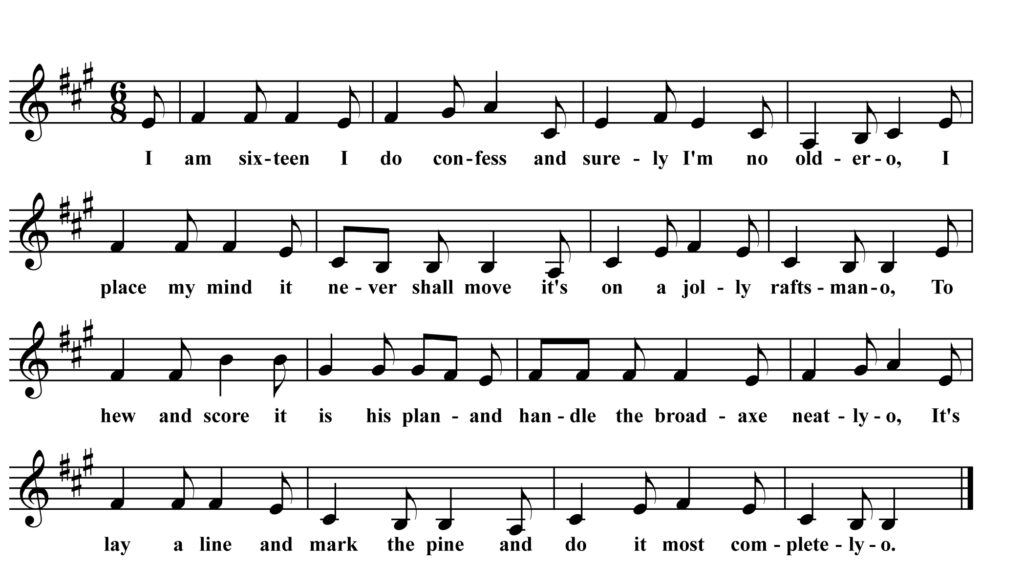
I am sixteen, I do confess, surely I’m no older-o,
I place my mind, it never shall move, it’s on a jolly raftsman-o.
Chorus: To hew and score it is his plan and handle the broad axe neatly-o,
It’s lay a line and mark the pine and do it most completely-o.
My mother’s daily scolding me to marry some freeholder-o,
I place my mind, it never shall move, it’s on a jolly raftsman-o.
My love is marching through the pine as brave as Alexander-o,
None can I find to please my mind as well as a jolly raftsman-o.
And now he rides the rushing stream and smiles at all the danger-o,
I love the raft where my love laughs, my poor but jolly raftsman-o.
And now he leaps from log to log as light as any dancer-o,
And if my man would ask for my hand, I know what I would answer-o.
Prolific Canadian song catcher Edith Fowke recorded this song from the singing of Grace Fraser née MacDonald from Glengarry County, Ontario. Glengarry County is at the extreme eastern tip of southern Ontario and has a historically high concentration of highland Scots. Up until the end of the 20th century there were still locals who considered Scots Gaelic their native tongue. Mrs. Fraser learned it from her mother, Johanna MacDonald née McGillis who herself got it from her own lumberjack father Ranald McGillis.
The references hewing, scoring and laying “the line” reflect the square timber logging practice common when the industry first came to the Ontario woods. The girl’s confession that she is sixteen years old does not necessarily imply that she was younger than the object of her affection. It was common in those days for men to take their first lumbering job at the age of 14 or 15!
Mrs. Fraser only had the first three verses and chorus given above. I created the 4th and 5th verses myself with some inspiration from other Ontario songs about raftsmen. I put together this version 12 years ago and recorded it with Randy Gosa on the CD The Falling of the Pine.