17 Feb

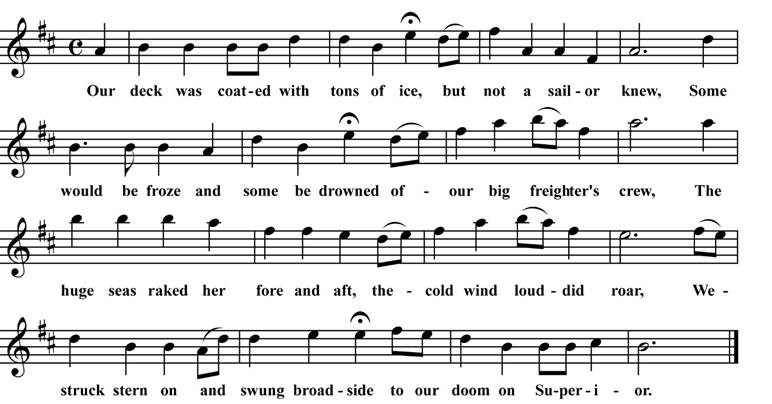
Doom on Superior

I am thinking of Lake Superior this month as I settle in to do music, along with the mighty Danny Diamond, for the play Whoosh! at the History Theatre in St. Paul. The Big Lake is a focus of the play (along with logging camps, the Civil War, Irish immigration and St. Anthony Falls) and, while looking for traditional songs relating to Lake Superior, I was reminded of this orphaned verse. The above text appears in William Ratigan’s 1960 book Great Lakes Shipwrecks & Survivals with this somewhat ambiguous note:

In its original form the ballad on the preceding page celebrated the loss of the vessel Antelope, presumably in Lake Michigan. Guesswork also fixes her as a schooner and the odds are in favor of the guess. There were thirteen Antelopes on the Lakes: seven schooners, two propellers, one brig, one scow, one barge, and one tug. They capsized and burned and foundered and were lost all over the various Lakes. But two of the schooners were wrecked on Lake Michigan in the year 1894, and therefore this date is applied to the song, which later became popular in the recital of other disasters, as shown in the adapted stanzas above.

Ratigan’s note seems to say that the verse was part of a localized variant of an earlier song about an Antelope that sank on Lake Michigan. The Lake Michigan song does exist and was documented by Ivan Walton and Edith Fowke who collected full versions of the song about Lake Michigan’s Antelope. I took the above melody from Fowke’s recording of “Skipper” Charles Henry Jeremy Snider of Toronto whose rendition appears on the Folkways album Songs of the Great Lakes. The book Songs of the Great Lakes Sailors by Walton and Grimm includes the Lake Superior verse as an addendum to an eight stanza version of the Lake Michigan song without giving a source for the fragment.

Ballad scholar Robert Waltz has theorized that the Lake Superior verse might refer to the 1897 wreck of the schooner Antelope off Michigan Island in the Apostle chain. That Antelope had been downgraded to a barge by the time it sank and no sailors were lost in the wreck so it’s not a perfect fit for the verse above.

So… it’s one to keep searching for! The verses from the Lake Michigan song could be reworked to go along with the Superior verse but I also hold out hope that the full Superior text must be out there somewhere. From Ratigan’s note, it could be that the Superior song was about a ship of a different name altogether. Stay tuned!

05 Jun

The First Day of April

The first day of April I’ll never forget,
When three English blades together had met,
They mounted on horseback and swore bitterly,
That they’d play a trick on the first man they’d see and sing…
Fol-de-dal-lol-ladly, fol-de-dal-lol-ladly,
Laddelyfol-lol-de-dal-lay, laddely-fol-de-dal-lee.

At Campbell the Rover they happened to spy,
He came from Tyrone, a place called The Moy,
And they saluted Campbell and he done the same,
And in close conversation together they came and sing…

They rode right along and they made a full stop,
They called upon Paddy for to take a drop,
And Paddy consented and said with a smile,
“I long for to taste the good ale from Carlisle” sing…

They ate and they drank and they sported as well,
Until forty eight shillings to pay up a bill,
Likewise for their horses some oats and good hay,
And they thought they’d leave Paddy the rattling to pay and sing…

Out of the house one by one then they stole,
They thought they’d leave Paddy to pay for the whole,
The landlord came in and this he did say,
“I’m afraid Irish Pat they’ve a trick on you played” and sing…

“Never mind them,” says Pat, “although they’re gone away,
I’ve got plenty of money the rattling to pay.
If you’ll sit down beside me before that I go,
I will tell you a secret perhaps you don’t know” and sing…

“I’ll tell you a secret contrary to law,
That two kinds of wine from one puncheon I’ll draw,”
And the landlord was eager to find out that plan,
And away to the cellar with Paddy he ran.

He bored a hole in a very short space,
And he bade the landlord place his thumb on that place,
The next one he bored, “Place the other one there,
And I for a tumbler will go up the stair” and sing…

Pat mounted his horse and was soon out of sight,
The horser came in to see if all was right,
They hunted the house from the top to the ground,
And half dead in the cellar the master he found sing…

I wish I would have come across this light-hearted song about pranking and counter-pranking a couple months ago. It’s the perfect April Fools Day song – even set on “the first day of April!” A version of this was sung in Ireland by Joe Heaney who called it “Campbell the Rover.” Variants were also collected in the Canadian Maritimes but the version above is from the vast repertoire of Johnny Green of Beaver Island, Michigan. As with most of Green’s songs, you can listen to a 1938 recording Alan Lomax made of Green singing it on the Library of Congress website. I did my best to transcribe Green’s melody and quirky chorus note-for-note but I made a couple small tweaks to his text to improve a rhyme and to help the story make sense.

I’ll be talking about Green’s life and playing recordings of his songs at a lecture on the music of Beaver Island that I’m giving this month at the Center for Irish Music’s Minnesota Irish Music Weekend. Come if you can!

13 May

The Gallagher Boys

Come all brother sailors I hope you’ll draw nigh,
For to hear of the sad news, it will cause you to cry,
Of noble Johnny Gallagher, who sailed to and fro,
He was lost on Lake Michigan where the stormy winds blow.

It was in October in seventy three,
We left Beaver harbor and had a calm sea,
Bound away to Traverse City, our destination to go,
We were crossing Lake Michigan where the stormy winds blow.

We left Traverse City at nine the next day
And down to Elk Rapids we then bore our way,
We took in our store and to sea we did go,
We were crossing Lake Michigan where the stormy winds blow.

At nine that same night a light we did spy,
That is Beaver Island, we are drawing nigh,
We carried all sails, the Lookout, she did go,
We were crossing Lake Michigan where the stormy winds blow.

Oh Johnny got up and he spoke to his crew,
He says, “My brave boys, now be steady and true,
Stand by your fore halyards, let your main halyards to,
There’s a squall on Lake Michigan where the stormy winds blow.”

The Lookout’s she’s a-runnin’ before a hard gale.
Upset went her rudder and overboard went her sail,
The billows were foaming like mountains of snow.
We shall ne’er cross Lake Michigan where the stormy winds blow.

Says Owen, “Brother Johnny, it grieves my heart sore,
To think we will never return to the shore,
God help our poor parents, their tears down will flow,
For we’ll sleep in Lake Michigan where the stormy winds blow.”

I am looking forward to a talk on the Irish music of Beaver Island, Michigan that I will be giving in June at the Center for Irish Music’s Minnesota Irish Music Weekend! In anticipation of that, I thought I would share song composed on Beaver Island this month: “The Gallagher Boys.”

Island singer Dominick Gallagher was six years old in 1873 when word came to the island that a boat went down in a gale while making the 70 mile return trip from a supply run to Traverse City. Dominick’s own father, Dominick Sr., had left on the same boat and was assumed to be among the lost.

“…when the news came and the report was that all hands was lost, I remember runnin’ and hangin’ around mother. I couldn’t realize what they were all cryin’ about. I had six sisters and they were all home and they were all cryin’, too. That night they had a wake and all, just as though he was there, and all the next day the neighbors came around.”
-Dominick Gallagher to Alan Lomax, 1938

(transcribed from this recording)

Miraculously, Dominick Sr. returned the next day. His friend Captain Roddy had also been in Traverse City and had convinced him not to make the crossing. Still, the Beaver Islanders who did venture out (including a Johnny Gallagher) were lost and the above song was composed shortly after by local song-maker Dan Malloy.

Above is my transcription of Dominick’s own melody and four verse text as sung for Lomax with the addition of three verses (1, 4 and 5 above) that were sung that same year by fellow Islander Johnny Green who had a much longer version of the song.