Doom on Superior
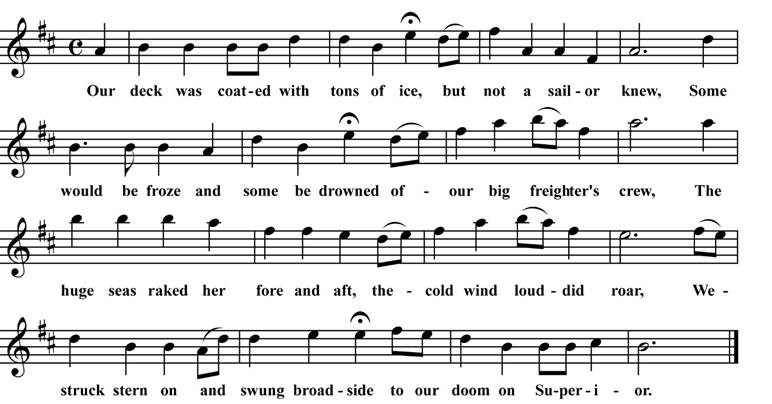
I am thinking of Lake Superior this month as I settle in to do music, along with the mighty Danny Diamond, for the play Whoosh! at the History Theatre in St. Paul. The Big Lake is a focus of the play (along with logging camps, the Civil War, Irish immigration and St. Anthony Falls) and, while looking for traditional songs relating to Lake Superior, I was reminded of this orphaned verse. The above text appears in William Ratigan’s 1960 book Great Lakes Shipwrecks & Survivals with this somewhat ambiguous note:
In its original form the ballad on the preceding page celebrated the loss of the vessel Antelope, presumably in Lake Michigan. Guesswork also fixes her as a schooner and the odds are in favor of the guess. There were thirteen Antelopes on the Lakes: seven schooners, two propellers, one brig, one scow, one barge, and one tug. They capsized and burned and foundered and were lost all over the various Lakes. But two of the schooners were wrecked on Lake Michigan in the year 1894, and therefore this date is applied to the song, which later became popular in the recital of other disasters, as shown in the adapted stanzas above.
Ratigan’s note seems to say that the verse was part of a localized variant of an earlier song about an Antelope that sank on Lake Michigan. The Lake Michigan song does exist and was documented by Ivan Walton and Edith Fowke who collected full versions of the song about Lake Michigan’s Antelope. I took the above melody from Fowke’s recording of “Skipper” Charles Henry Jeremy Snider of Toronto whose rendition appears on the Folkways album Songs of the Great Lakes. The book Songs of the Great Lakes Sailors by Walton and Grimm includes the Lake Superior verse as an addendum to an eight stanza version of the Lake Michigan song without giving a source for the fragment.
Ballad scholar Robert Waltz has theorized that the Lake Superior verse might refer to the 1897 wreck of the schooner Antelope off Michigan Island in the Apostle chain. That Antelope had been downgraded to a barge by the time it sank and no sailors were lost in the wreck so it’s not a perfect fit for the verse above.
So… it’s one to keep searching for! The verses from the Lake Michigan song could be reworked to go along with the Superior verse but I also hold out hope that the full Superior text must be out there somewhere. From Ratigan’s note, it could be that the Superior song was about a ship of a different name altogether. Stay tuned!