17 Feb

Albert Bulow

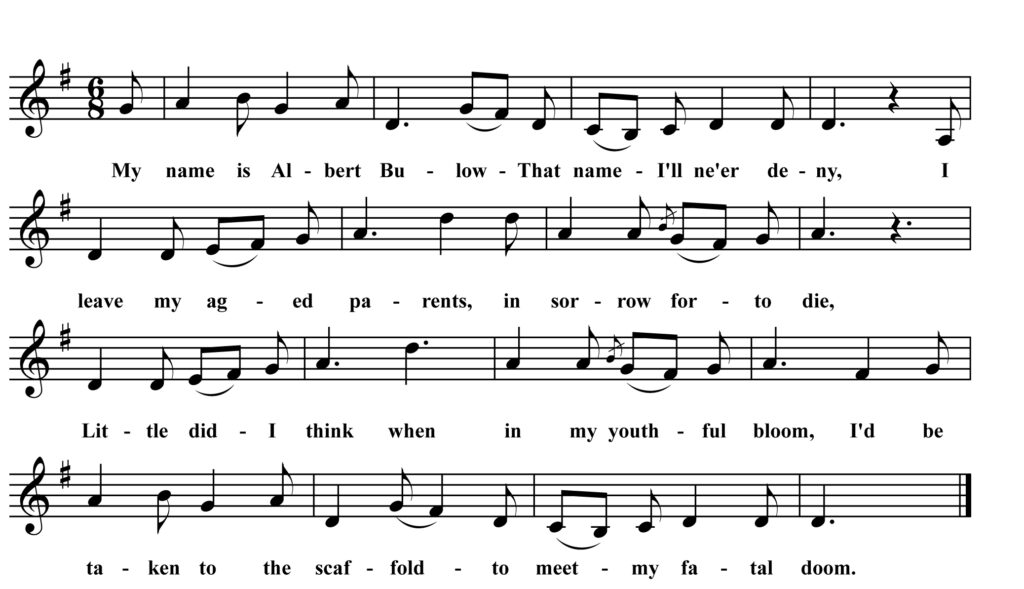
My name is Albert Bulow, that name I’ll never deny,
I leave my aged parents in sorrow for to die,
Little did I think, when in my youthful bloom,
I’d be taken to the scaffold, to meet my fatal doom.

Come, all you tender Christians, where ever you may be,
And likewise pay attention to these few lines you see,
For the murder of Franklin Eich, I am condemned to die,
On the nineteenth day of July, upon the scaffold high.   Cho.

It was in the city of Verndale I tried to make escape,
But Providence being against me, it proved to be too late,
They took me to the prison, all in my youthful bloom.
And now to the scaffold I must go to meet my fatal doom. Cho.

A mob thought to lynch me but the sheriff was warned in time,
And with Randall and their victim to Brainerd he did flee,
We left the angry mob all in their wrought up glee,
To leave the court of mercy deal justice unto me. Cho.

My friends came to see me and bid their last adieu,
They spoke their words of kindness and wept most bitterly.
And said to me, dear Albert, to-day you’ve got to die,
For the murder of Franklin Eich, upon the scaffold high. Cho.

Come, all young men, a warning take from me,
And leave a wild and sporting life; it leads to misery,
Bad company first, then liquor came in time;
It brought me down to the lowest, and to this awful crime. Cho.

It is sad, my friend, to leave you and bid you all good-bye,
But Fate is all against me and I am doomed to die,
That justice has been dealt to me, I’m not prepared to tell,
But God will treat me justly, he doeth all things well.

We start this year with a rare ballad that was actually printed as a broadside here in Minnesota in 1889. If newspaper accounts are true, it is also an example of a “gallows ballad” actually composed by the condemned criminal himself. The Morrison County Historical Society has an original broadside the heading of which reads:

EXECUTION SONG.
LITTLE FALLS, MINN. JULY 15, 1889
[WORDS COMPOSED BY ALBERT BULOW]
FIRST LINES SUNG AS CHORUS
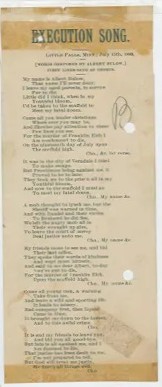
Bulow’s broadside from the Morrison Co. Historical Society

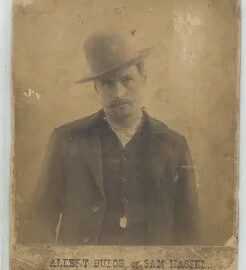
The murder of well-to-do farmer Franklin Eich outside of Royalton, Minnesota in October 1888 and the subsequent apprehension, trial and hanging of Albert Bulow was followed closely in the Little Falls newspapers as well as papers in the Twin Cities. Bulow was hanged for his crime in Little Falls at 1:52AM on July 19, 1889.

The Minneapolis Journal on July 18th wrote:

Bulow, in order to beguile the tedious hours of waiting until death shall set him free, has composed a little song which he calls his death song. There is not much poetry in the piece and Bulow does not pretend that he has made much of a success of his poem but he has had it printed all the same and has been selling copies of it at 5 cents a copy. What Bulow proposes to do with the money he has raised in this peculiar way he does not say. It is all the money he has.

The St. Paul Daily Globe on July 19th reported that Bulow possessed “the German love of music” and that the jailer’s wife organized a quartet for the prisoner in which “Bulow’s voice was never below the others.” The same article reports that:

A few days ago, with the assistance of his night watch, he ground out a poem on himself, which was printed and sold to curious visitors at 15 cents per copy.  

Bulow’s song, in typical folk song fashion, was clearly modeled on the earlier American-made gallows ballad “James Rogers” (Rodgers was executed in 1858). I matched the Bulow text to the melody song for the James Rogers song by Minnesota singer Mike Dean (which I shared in the June 2023 Northwoods Songs).
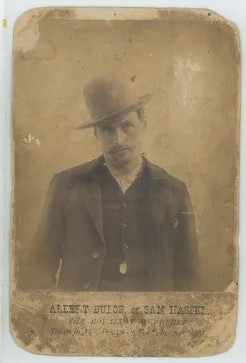
Albert Bulow. Morrison Co. Historical Society
10 Feb

The Wexford Girl

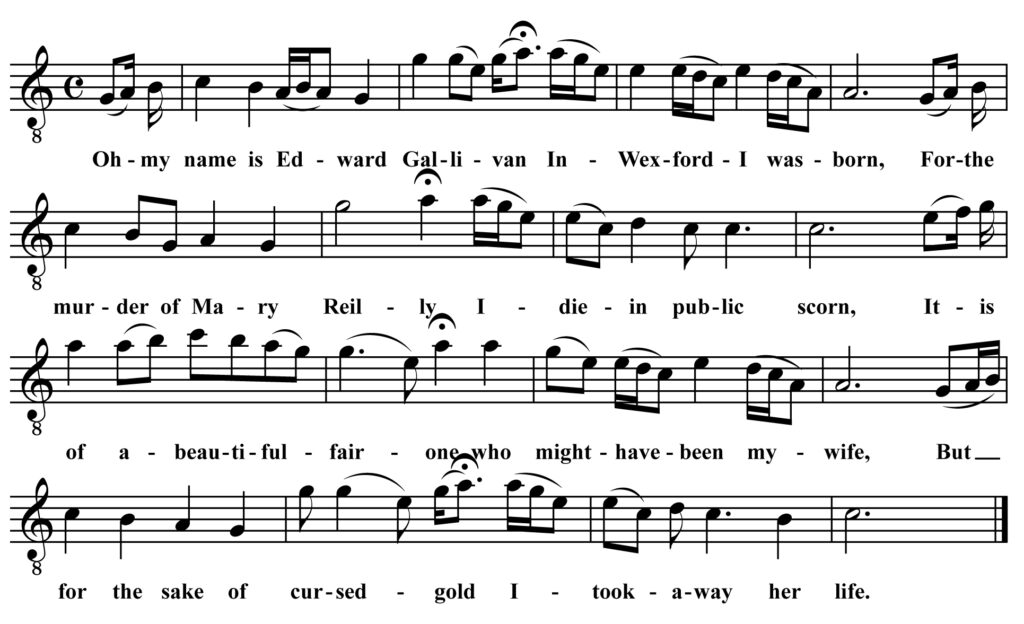
Oh my name is Edward Gallivan, in Wexford I was born,
For the murder of Mary Reilly I die in public scorn,
It is of a beautiful fair one who might have been my wife,
But for the sake of curs-ed gold I took away her life.

When first I kept her company her friends did on me frown,
And by her hard indust-o-ry she saved twenty pounds,
She believed my false vows but I led her quite astray,
Saying, “My dear we will sail without delay unto Americay.”

Oh those words that she had said to me would grieve your heart full sore,
Before that I had murdered her and left her in her gore,
She said, “Dear James here are my keys and in my box you will find
An order on the savings bank for the sum of twenty pounds.”

“Your money it will take me unto some foreign shore,”
I then gave her a deadly blow, I need not say no more,
With a loaded whip I murdered her, her body I concealed,
Her blood it cried for vengeance, the murder soon revealed.

Oh I was apprehended, as you may plainly see,
May the Lord look to my sinful soul, give me some time to pray,
The judge he made me answer, “You gave no time to pray,
To that innocent young creature whose life you took away.”

Oh, now my song is ended, I mean to drop my pen,
I hope my fate a warning will be to every young man,
I hope my fate a warning to young and old may be,
To shun drinking and night walking and keep good company.

We have another song from the masterful voice of New Brunswick singer Angelo Dornan this month. There is a fairly well-travelled ballad also called “The Wexford Girl” that song scholar Robert Waltz and others have recognized to be a separate story than this grim murder ballad. In Dornan’s song, the man lament’s his horrific crime that resulted from his greed for money.

The above is my own transcription of Dornan’s singing which is now available to hear via the Nova Scotia Archives site. After singing the text above, Dornan added this half verse implicating Satan himself:

I had not gone one mile with her until Satan tempted me
For to rob her of her money and then her butcher be.

As usual with Dornan, it’s his beautiful singing and the enticing little twists and turns of his fluid version that draw me to this otherwise very dreary song!

13 Jun

Jack Rogers

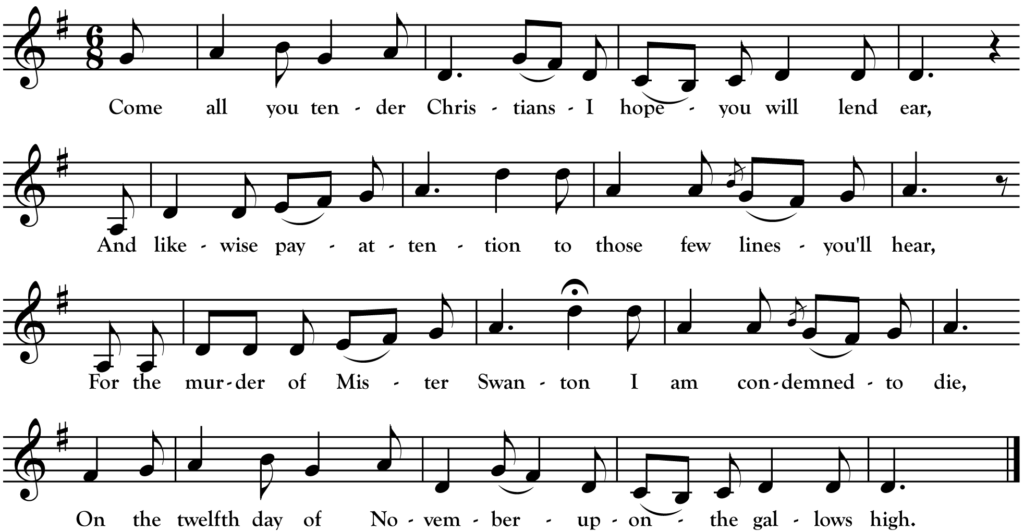
Come, all you tender Christians, I hope you will lend ear,
And likewise pay attention to those few lines you’ll hear,
For the murder of Mr. Swanton I am condemned to die,
On the twelfth day of November upon the gallows high.

My name it is Jack Rogers, a name I’ll ne’er deny,
Which leaves my aged parents in sorrow for to cry,
It’s little did they ever think, all in my youthful bloom,
That I would come unto New York to meet my awful doom.

My parents reared me tenderly as you can plainly see,
And constant good advice they used to give to me,
They told me to shun night walking and all bad company,
Or state’s prison or the gallows would be the doom of me.

But it was in play houses and saloons I used to take delight,
And constantly my comrades they would me there invite,
I oft times was told by them that the use of knives was free,
And I might commit some murder and hanged I ne’er would be.

As Mr. Swanton and his wife were walking down the street,
All in a drunken passion I chanced them for to meet,
I own they did not harm me, the same I’ll ne’er deny,
But Satan being so near me, I could not pass them by.

I staggered up against him, ’twas then he turned around,
Demanding half the sidewalk, also his share of ground,
’Twas then I drew that fatal knife and stabbed him to the heart,
Which caused that beloved wife from her husband there to part.

It was then I went to Trenton, thinking to escape,
But the hand of Providence was before me, indeed I was too late,
It was there I was taken prisoner and brought unto the Toombs,
For to die upon the gallows, all in my youthful bloom.

I am thankful to the sheriff, who has been so kind to me,
Likewise my worthy counsellors, who thought to set me free,
And also to the clergyman, who brought me in mind to bear,
For to die a true penitent I solemnly do declare.

The day of my execution it was heartrending to see,
My sister came from Jersey to take farewell of me,
She threw herself into my arms and bitterly did cry,
Saying, “My well beloved brother, this day you have to die.”

And now my joys are ended, from this wide world I must part,
For the murder of Mr. Swanton I’m sorry to the heart;
Come, all you young ambitious youths, a warning take from me,
Be guided by your parents and shun bad company.

Sometimes doing the research into an old song’s background unlocks emotional weight that is hard to access from the words and melody alone. I found that to be the case with this grim ballad that was sung by Minnesotan Michael Dean, printed in his 1922 songster The Flying Cloud and subsequently recorded from Dean’s singing by Robert Winslow Gordon in 1924.

When I first came across it, it seemed like a tragedy in the form of a classic Irish come-all-ye like “The Croppy Boy” but without a noble cause behind the punished crime. It turns out that “Jack Rogers” describes a real and widely-publicized New York City murder from October 1857. Though there is no worthy motive here, the song sheds light on the hard and sometimes violent culture of Irish immigrant youths who came to New York in the wake of the Great Hunger.

Newspapers of the time reported that the “respectable old gentleman” John Swanston was returning from a market on a Sunday evening with his wife when they met three young Irish “loungers about the corners” at the corner of 10th Avenue and 21st Street. One of the three, 19-year-old Irish immigrant James Rodgers, allegedly provoked Swanston by letting his elbow stick out and hit him. An altercation ensued in which Swanston was fatally stabbed. Rodgers fled to a sister’s home in New Jersey but was apprehended and jailed in The Tombs – the Manhattan House of Detention of that time. After many appeals and much publicity, Rodgers was sentenced and hanged at The Tombs on November 12th, 1858.

Rodgers maintained throughout his captivity that he remembered nothing of the crime. This was generally attributed in the press, and in the subsequent ballad, to his being heavily intoxicated under the encouragement of his two friends. The song’s admonition to “shun bad company” sums up the newspapers’ take on the crime and the song could well have been written by someone who had access to the November 13th, 1858 New York Herald which lays this all out in detail.

Articles also talk about how exceptionally young, gentle and handsome Rodgers was and that he was always restrained and, if anything, sad when interviewed. He was well-loved by his family and the newspaper descriptions of their heartbroken hysteria at his execution are painful to read 115 years later. It is easy to see how the story inspired public sympathy. A prominent author of the time, Caroline Kirkland, even lobbied New York’s governor in hopes of staying the execution. In the end, Rodgers’ fate was held up as a warning to other potentially violent young men on New York’s streets.

The Library of Congress has a broadside ballad sheet of “The Lamentation of James Rodgers” that is clearly a match for the version sung by Michael Dean. Dean’s version (where the names have changed somewhat) is one of only a couple found in circulation among US singers. Another version was collected in Newfoundland and, interestingly, two versions turned up in Ireland. Sam Henry’s unpublished collection has one from the north and a snippet of a version from Kerry can be heard via the Muckross House Research Library site online.

Also, this is a good blog post about the James Rodgers crime and execution.