17 Feb

Katahdin

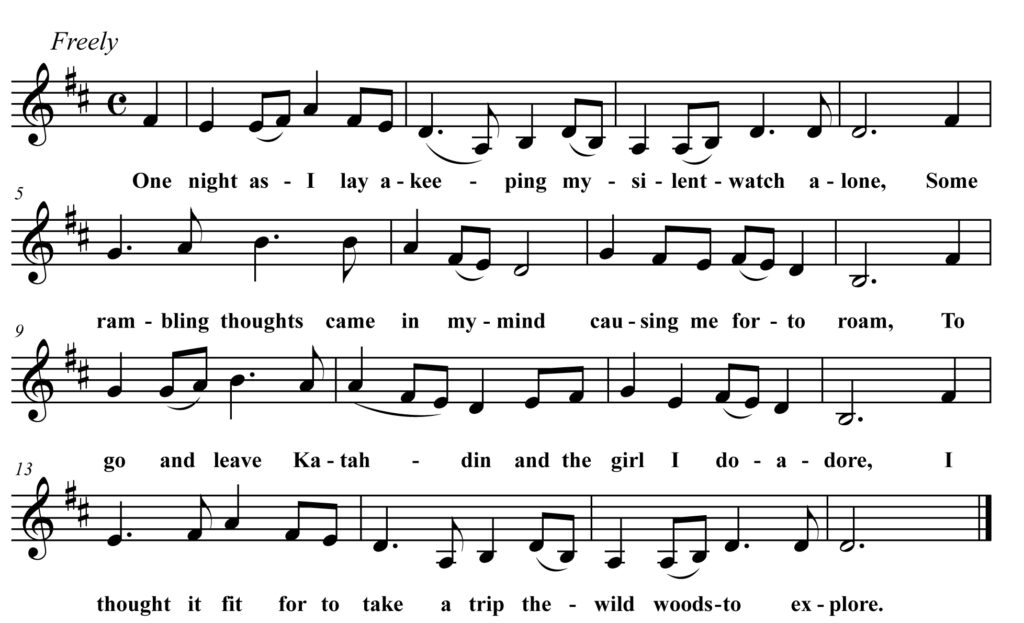
One night as I lay a-keeping my silent watch alone,
Some rambling thoughts came in my mind, causing me for to roam,
To go and leave Katahdin and the girl I do adore,
I thought it fit for to take a trip, the wild woods to explore.

I took my true love by the hand and to help her I did say,
“My train it leaves tomorrow, my dear I must away,
But as we gently glide along, we will cause every tavern to roar,
Drinking health to old Katahdin and the girls we do adore.”

Katahdin it’s a pretty place with pretty girls therein,
You’d think that they were nightingales, were you to hear them sing,
And little lambs they sport and play all by their mother’s side,
And the salmon, trout and pickerel in the streams do gently glide.

When I arrived in Sancook the people gathered round,
They said I wasn’t able, the tall pine to cut down,
But I could hire as a cookee if I kept snug and clean,
Well, that was the very first time that I missed Katahdin green.

Well, the winter is now over, and the teams, they’re coming out,
Our boss he calls the men to him to hire them for the route,
“It is to those who will stay here, high wages I’ll pay to ye,
And when the lumber is in Old Town you routers may go free.”

My hand it’s growing tired, no more can I pen down,
I hope our boss’s lumber arrives safe in Old Town,
And when we get to Bangor, we will cause every tavern to roar,
Drinking health to old Katahdin and the girls we do adore.

The Penobscot word for “great mountain” gives us the name Katahdin for the tallest mountain in the state of Maine. In small towns like those near Mount Katahdin it was once common for teenaged boys to set out in the fall in search of winter employment in a live-in logging camp. Some such boys had fathers who came from the north of Ireland where seasonal work at harvest time in Scotland drew young men over the North Channel each year. This could explain why “Katahdin” seems to be a variant of the song known in the north of Ireland as “Brockagh Brae” or “The Roslea Farewell” (Roud 5171) that references the Ireland to Scotland work pattern.

I developed the above version based on that collected from Ambrose Herrell in Prince Edward Island and printed in Folksongs from Prince Edward Island by Randall and Dorothy Dibblee. I recorded it on the album Minnesota Lumberjack Songs and plan to release a new version with Danny Diamond on the upcoming Northern Shores album. The PEI version is still my favorite but I have since discovered interesting variants collected in Michigan, New Brunswick and West Virginia.
22 Aug

Once More A-Lumbering Go

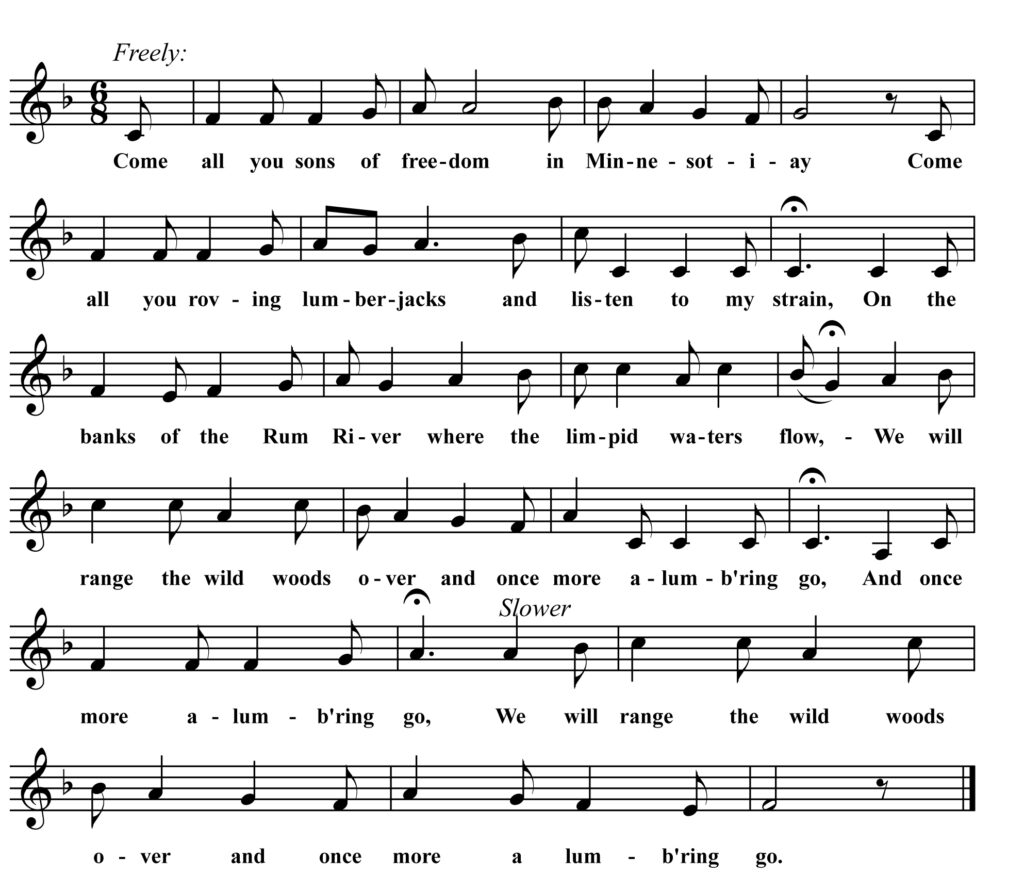
Come all you sons of freedom in Minnesot-i-ay,
Come all you roving lumberjacks and listen to my strain,
On the banks of the Rum River where the limpid waters flow,
We will range the wild woods over and once more a-lumbering go,

And once more a lumbering go,
We will range the wild woods over and once more a-lumbering go.

With our cross-cut saws and axes we will make the woods resound,
And many a tall and stately tree will come crashing to the ground,
With cant-hooks on our shoulders to our boot tops deep in snow,
We will range the wild woods over and once more a-lumbering go,

And once more a lumbering go,
We will range the wild woods over and once more a-lumbering go.

You may talk about your farms, your houses and fine places,
But pity not the shanty boys while dashing on their sleigh,
For around the good campfire at night we’ll sing while wild winds blow,
And we’ll range the wild woods over and once more a-lumbering go,

And once more a-lumbering go,
We will range the wild woods over and once more a-lumbering go.

Then when navigation opens and the water runs so free,
We’ll drive logs to St. Anthony once more our girls to see,
They will all be there to welcome us and our hearts in rapture flow,
We will stay with them through summer then once more a-lumbering go,

And once more a-lumbering go,
We will stay with them through summer, then once more a-lumbering go.

When our youthful days are ended and our stories are growing old,
We’ll take to us each man a wife and settle on the farm,
Enough to eat, to drink, to wear; content through life we go,
We will tell our wives of our hard times, and no more a-lumbering go,

And no more a-lumbering go,
We will tell our wives of our hard times, and no more a-lumbering go.

I am working this month with St. Paul playwright Jeremiah Gamble of the Bucket Brigade Theater on a new play called Shanty Boys of Pine County that will feature songs and stories from my research. One song we were considering for the play is “Once More A-Lumbering Go” (sometimes called “The Logger’s Boast”) as recorded by Alan Lomax in St. Louis, Michigan in 1938 from the singing of Carl Lathrop. I learned Lathrop’s version years ago. It features place names of the Saginaw area and, as I am always drawn to Minnesota-specific songs, I stopped singing it at some point.

Much to my delight, when I started looking around for other versions, I came across a fragment localized to the Rum River here in Minnesota! It turns up in an intriguing article published April 27, 1947 in the Minneapolis Journal about the establishment here of a Folk Arts Foundation of Minnesota. The article references the Finnish and Scots Gaelic songs recorded by Sidney Robertson in northeastern Minnesota (see Laura MacKenzie’s wonderful From Uig to Duluth project!) and calls for more field recording to be done in Minnesota.

The article includes a fragment of “Once More A-Lumbering Go” submitted by Elizabeth Sadley of Minneapolis. Sadley writes:

…I am sending you the words, as far as I can recall, of a lumberjack song that my mother used to sing.

My mother has been dead several years, and the verses here are only a fragment of the entire song. Perhaps some one of my mother’s generation can complete the words. The tune is very simple.

My family moved to Princeton, Minn., about 1875. My father operated two grist mills and supplied the lumber camps in the Mille Lac lake area. This song was sung by the lumberjacks who floated the logs down both branches of the Rum river to the saw mills.

Sadley’s fragment is lines 3 & 4 of the first and last verses above along with the chorus of verse one. I created lines 1 & 2 of the first and fourth verses to further localize the song to the Rum River story and transcribed the rest of the text and melody from Lomax’s recording of Lathrop.

10 Jan

Why Don’t My Father’s Ship Come In?

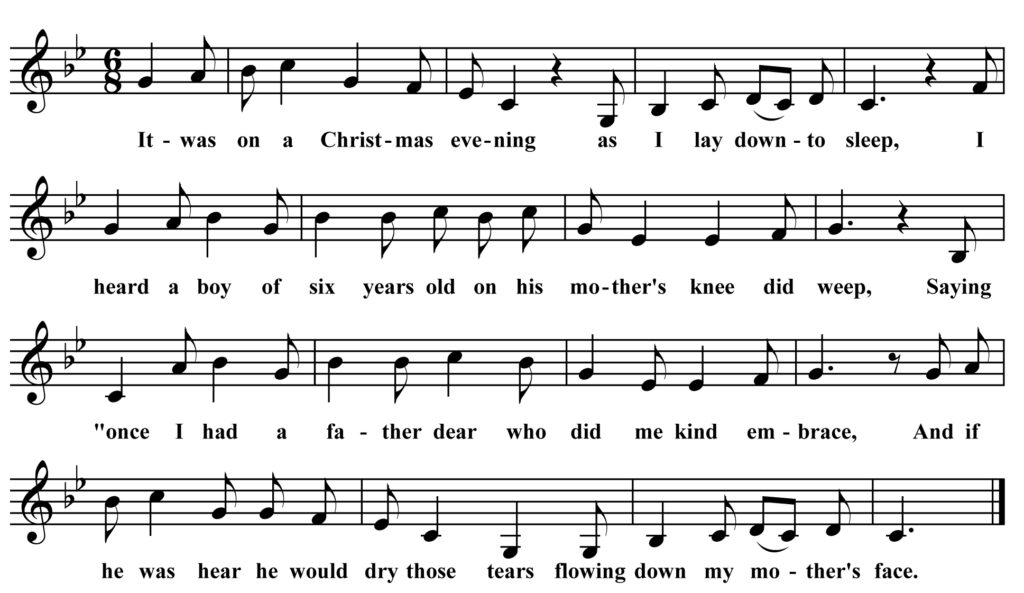
It was on a Christmas evening as I lay down to sleep,
I heard a boy of six years old on his mother’s knee did weep,
Saying “once I had a father dear who did me kind embrace
And if he was here, he would dry those tears flowing down my mother’s face”

Oh where is that tall and gallant ship that first bore him away,
With topsails soft and painted decks born by the breeze away,
While other ships are coming in splitting the icy foam,
Oh why don’t my father’s ship come in, and why don’t he come home?

Oh, dear son, your father has tarried for to cross the stormy sea,
The ocean and the hurricane sweeps he’ll never come back to me,
Dear son your father’s dead and gone to the home of the brave,
The stormy ocean and winter winds sweep o’er your father’s grave

Oh well I do remember when he took me on his knee,
And gave me all the fruits he bore from off that India tree,
He said six months he would be gone and here leave us alone,
But by those stormy winter winds, twelve months are past and gone.

Oh hush my darling little son your innocent life is done,
Now you and I are all that’s left for to lament and mourn,
You are the darling of my heart I will press you to my side,
And they rose their eyes to heaven and the son and mother died.

We return to Beaver Island, Michigan this month for a song from the repertoire of singer Johnny Green recorded by Alan Lomax during his 1938 visit to the island.

This dark and sorrowful lament for a father lost at sea appears in several collections across the north woods from the Canadian Maritimes to Ontario. Lomax’s recording of John Green is accessible via the Library of Congress website under the title (probably resulting from a mishearing of the first line) “Christmas Eve.”

Anita Best and Genevieve Lehr printed a version from Annie Green of Newfoundland in their book Come & I Will Sing You. Annie Green closed the song this way:

“My boy you’re the pride of all my heart,” as she pressed him to her breast,
And closed her eyes to the yonder skies where the weary ones find rest.