02 Jun

The Hinckley and Sandstone Fire
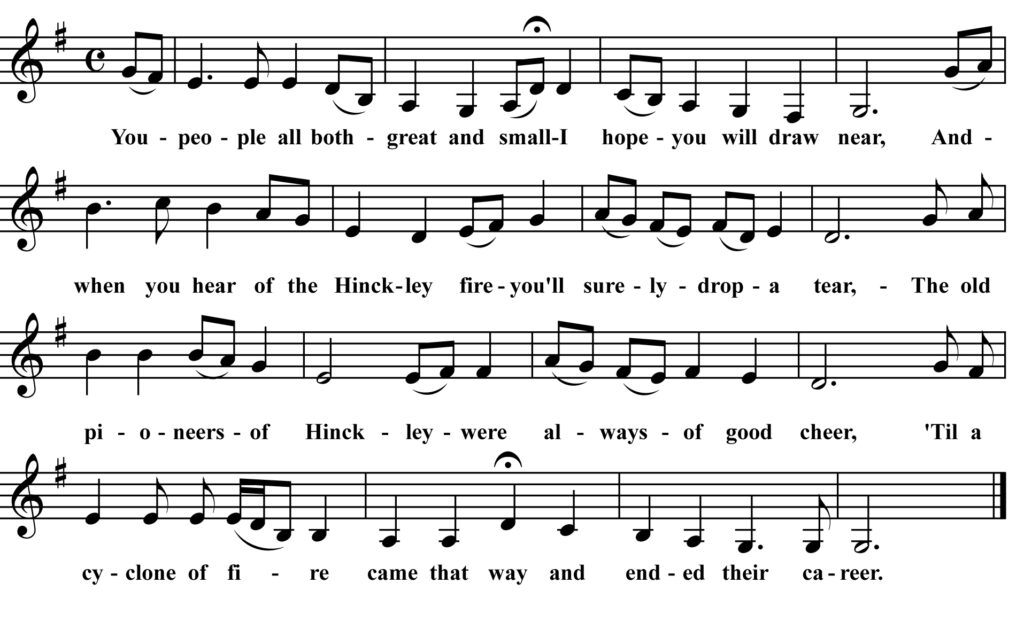
You people all, both great and small,
I hope you will draw near
And when you hear of the Hinckley fire,
You will surely drop a tear,
The old pioneers of Hinckley,
Were always in good cheer,
Until a cyclone of fire came that way,
And ended their career.

On the first day of September,
In eighteen ninety four,
Those bold, undaunted heroes,
Were driven from their doors.
Their wives and children for to save,
To the swamp they quickly bore,
And when I think of their sad fate,
It oftimes makes me sore.

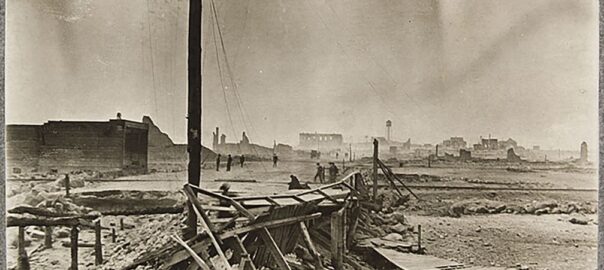
We have another fascinating fragment of a Minnesota-composed song this week. I found the above text in the Minnesota Historical Society’s microfilm copy of the January 3rd, 1895 Pine County Courier newspaper printed in Sandstone, Minnesota. It appeared just four months after the Hinckley Fire which ripped through both Hinckley and nearby Sandstone killing over 400 people.

The paper printed what it said were “a few stanza’s of a song composed by our talented townsman Dan Forin” further stating that “those desiring to secure this song can get it in book form of Dan Forin, Sandstone for 25 cents.”

Much has been written about the Hinckley Fire but I have never come across this song. Daniel Foren appears on the 1895 Minnesota Territorial Census in Sandstone, age 34 with his birthplace listed as Canada. The Courier gives us more information about Dan Forin including that he was the “lone fiddler” at mid-winter dances held at the home of his neighbor Steve O’Neill, an immigrant from Ireland. Forin was also a friend of Patrick Linehan at the time. Born in New York to Irish immigrant parents, Linehan was a fellow Sandstone fire survivor who “sang Irish ballads” at the same parties where Forin played his fiddle. Linehan would later settle in Minneapolis where, in the 1910s, he emerges as the first documented Minnesotan performer on uilleann pipes. Linehan’s set of William Rowsome pipes are now in the hands of Tom Dahill of St. Paul.

Forin and Linehan would have surely known Mike Dean who lived in Hinckley in the 1890s. They may have even been sources for some of the songs in Dean’s songster The Flying Cloud.

For a tune, I adapted the melody from the Newfoundland song “Gull Cove” as printed in the book Come and I will Sing You by Genevieve Lehr and Anita Best.

For more on Linehan, see this talk I gave during the 2026 Irish Arts Week at Celtic Junction Arts Center
10 Jan

Why Don’t My Father’s Ship Come In?

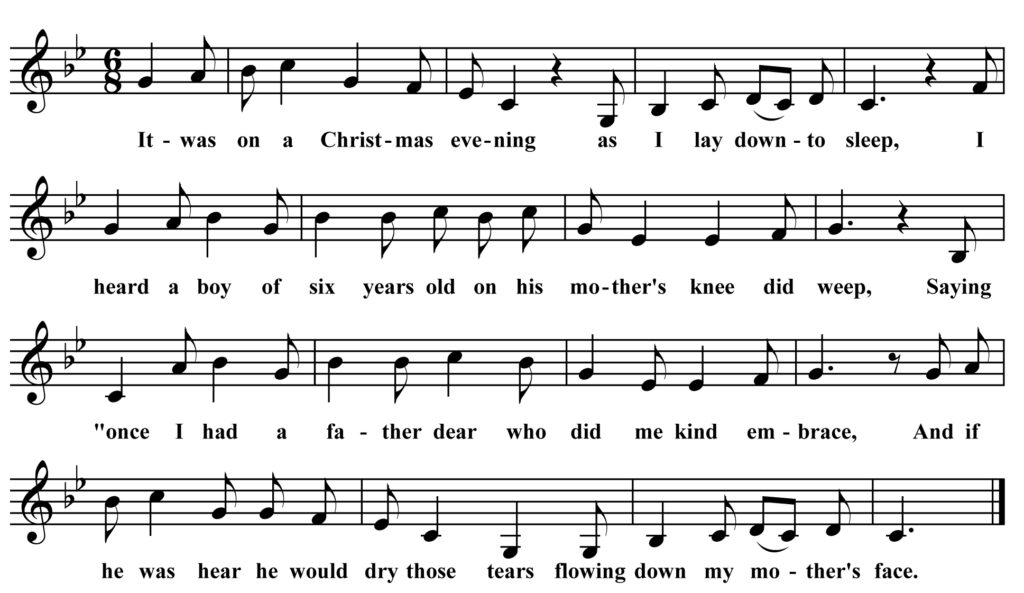
It was on a Christmas evening as I lay down to sleep,
I heard a boy of six years old on his mother’s knee did weep,
Saying “once I had a father dear who did me kind embrace
And if he was here, he would dry those tears flowing down my mother’s face”

Oh where is that tall and gallant ship that first bore him away,
With topsails soft and painted decks born by the breeze away,
While other ships are coming in splitting the icy foam,
Oh why don’t my father’s ship come in, and why don’t he come home?

Oh, dear son, your father has tarried for to cross the stormy sea,
The ocean and the hurricane sweeps he’ll never come back to me,
Dear son your father’s dead and gone to the home of the brave,
The stormy ocean and winter winds sweep o’er your father’s grave

Oh well I do remember when he took me on his knee,
And gave me all the fruits he bore from off that India tree,
He said six months he would be gone and here leave us alone,
But by those stormy winter winds, twelve months are past and gone.

Oh hush my darling little son your innocent life is done,
Now you and I are all that’s left for to lament and mourn,
You are the darling of my heart I will press you to my side,
And they rose their eyes to heaven and the son and mother died.

We return to Beaver Island, Michigan this month for a song from the repertoire of singer Johnny Green recorded by Alan Lomax during his 1938 visit to the island.

This dark and sorrowful lament for a father lost at sea appears in several collections across the north woods from the Canadian Maritimes to Ontario. Lomax’s recording of John Green is accessible via the Library of Congress website under the title (probably resulting from a mishearing of the first line) “Christmas Eve.”

Anita Best and Genevieve Lehr printed a version from Annie Green of Newfoundland in their book Come & I Will Sing You. Annie Green closed the song this way:

“My boy you’re the pride of all my heart,” as she pressed him to her breast,
And closed her eyes to the yonder skies where the weary ones find rest.

05 Jul

Two Irish Laborers

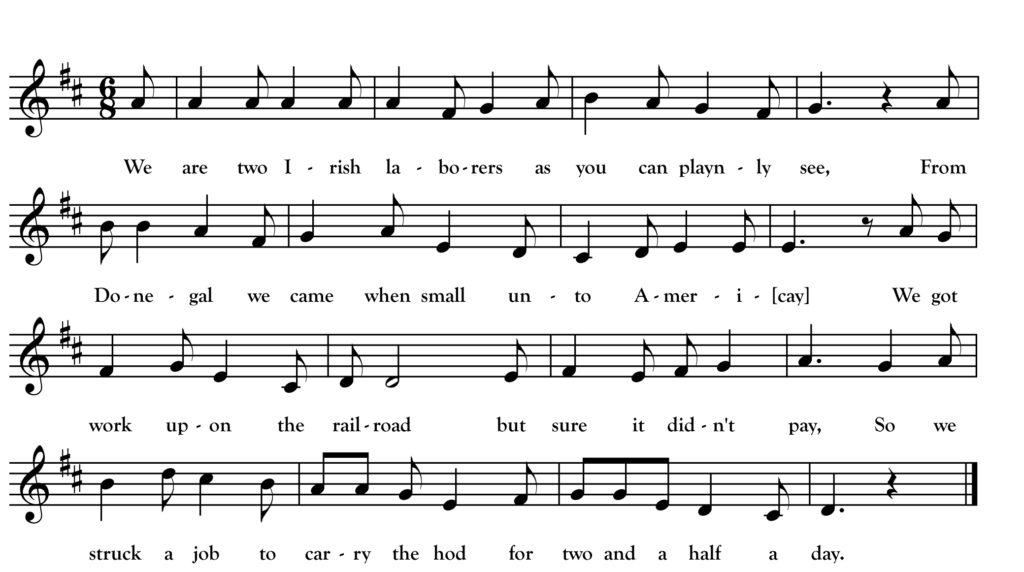
We are two Irish laborers, as you can plainly see,
From Donegal we came when small unto America;
We got work on the railroad, but sure it didn’t pay,
So we struck a job to carry the hod for two and a half a day.

                                        Chorus-
Pat, be quick, bring up the brick, the mortar, too, likewise,
Then push along and sing a song as up the ladder you rise;
I always thought it bully fun to be a mason’s clerk,
And have the man on top of the house for to do all the work.

When we go back to Ireland, that dear old Emerald Isle,
Where the stranger finds a welcome and is greeted with a smile,
Then if you ever want a friend you needn’t try too hard,
You’ll always find one in the Irish boys that carried the hod.

A hod is a box with only three sides (imagine three walls of a cube that meet at a corner with the rest of the cube removed). Often mounted at the end of a stick, it is used to carry bricks or mortar during construction work. The image of Irish immigrant men as “hod carriers” was a recurring trope on the American music hall stage in the late 1800s and that’s where this song seems to have originated. However, the text above comes from Minnesota singer Michael Dean who, like other singers in the woods tradition, had a repertoire that freely mixed music hall songs with come-all-ye ballads and other song types. I have not come across “Two Irish Laborers” in any other collections so it may have been rare in tradition. Dean also sang “When McGuiness Gets a Job” which also references the hod (“he’s the boy that can juggle the old three-cornered box”). “McGuiness” originated on the stage and turns up in song collections from the Catskills and Prince Edward Island.

Thanks to some online newspaper archive sleuthing, I was able to connect “The Two Irish Laborers” to an influential 19th century song and dance man named Dick Carroll. In April, 1924, The Brooklyn Standard Union ran a full page feature titled “Harking Back to the Good Old Days” in which one reader contributed this reminiscence: “In 1873, Dick Carroll, as the hod carrier, in his specialty of ‘Mortar and Bricks’ sang ‘Arrah, Pat be Quick Bring Up the Brick and the Mortar Too Likewise.’” According to Monarchs of Minstrelsy Carroll was born in New York City in 1832 and began performing publicly as a child before having a long career in minstrelsy and, later, the variety stage. He was known primarily as a dancer and Ryan’s Mammoth Collection even includes a tune called “Dick Carroll’s Clog.” “Mortar and Bricks” was his showpiece for many years.

With no luck finding a melody used by Dean or Carroll, I opted to borrow a melody sung by J. Molloy of St. Schott’s Newfoundland for another music hall song, “How Paddy Stole the Rope,” that has a similar opening line. Molloy’s unique and satisfying melody can be heard online via Memorial University’s fantastic digital collection “MacEdward Leach and the Songs of Atlantic Canada.”