17 Feb

Jolly Raftsman

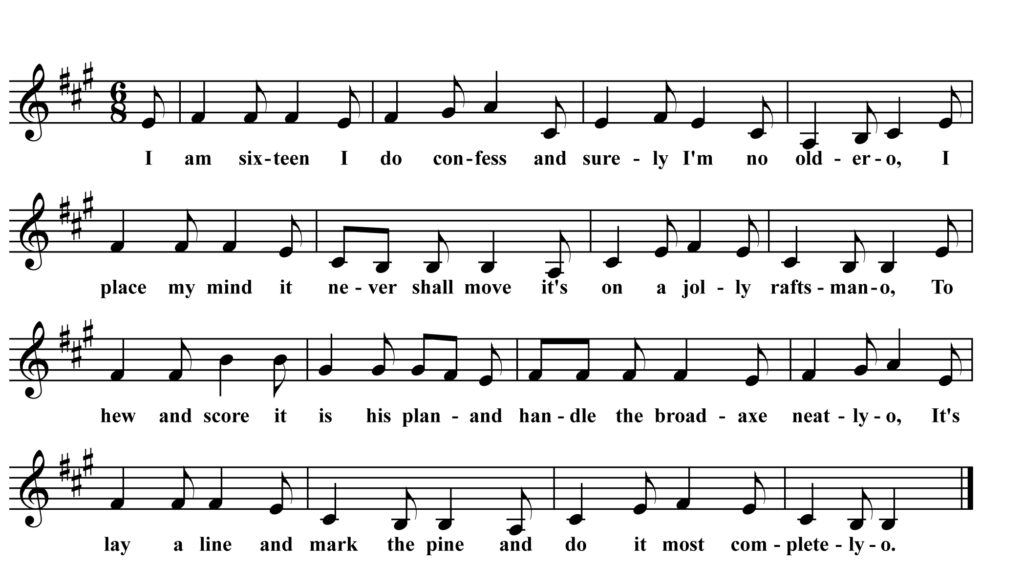
I am sixteen, I do confess, surely I’m no older-o,
I place my mind, it never shall move, it’s on a jolly raftsman-o.

Chorus:     To hew and score it is his plan and handle the broad axe neatly-o,
                  It’s lay a line and mark the pine and do it most completely-o.

My mother’s daily scolding me to marry some freeholder-o,
I place my mind, it never shall move, it’s on a jolly raftsman-o.
My love is marching through the pine as brave as Alexander-o,
None can I find to please my mind as well as a jolly raftsman-o.

And now he rides the rushing stream and smiles at all the danger-o,
I love the raft where my love laughs, my poor but jolly raftsman-o.
And now he leaps from log to log as light as any dancer-o,
And if my man would ask for my hand, I know what I would answer-o.

Prolific Canadian song catcher Edith Fowke recorded this song from the singing of Grace Fraser née MacDonald from Glengarry County, Ontario. Glengarry County is at the extreme eastern tip of southern Ontario and has a historically high concentration of highland Scots. Up until the end of the 20th century there were still locals who considered Scots Gaelic their native tongue. Mrs. Fraser learned it from her mother, Johanna MacDonald née McGillis who herself got it from her own lumberjack father Ranald McGillis.

The references hewing, scoring and laying “the line” reflect the square timber logging practice common when the industry first came to the Ontario woods. The girl’s confession that she is sixteen years old does not necessarily imply that she was younger than the object of her affection. It was common in those days for men to take their first lumbering job at the age of 14 or 15!

Mrs. Fraser only had the first three verses and chorus given above. I created the 4th and 5th verses myself with some inspiration from other Ontario songs about raftsmen. I put together this version 12 years ago and recorded it with Randy Gosa on the CD The Falling of the Pine.
17 Feb

Katahdin

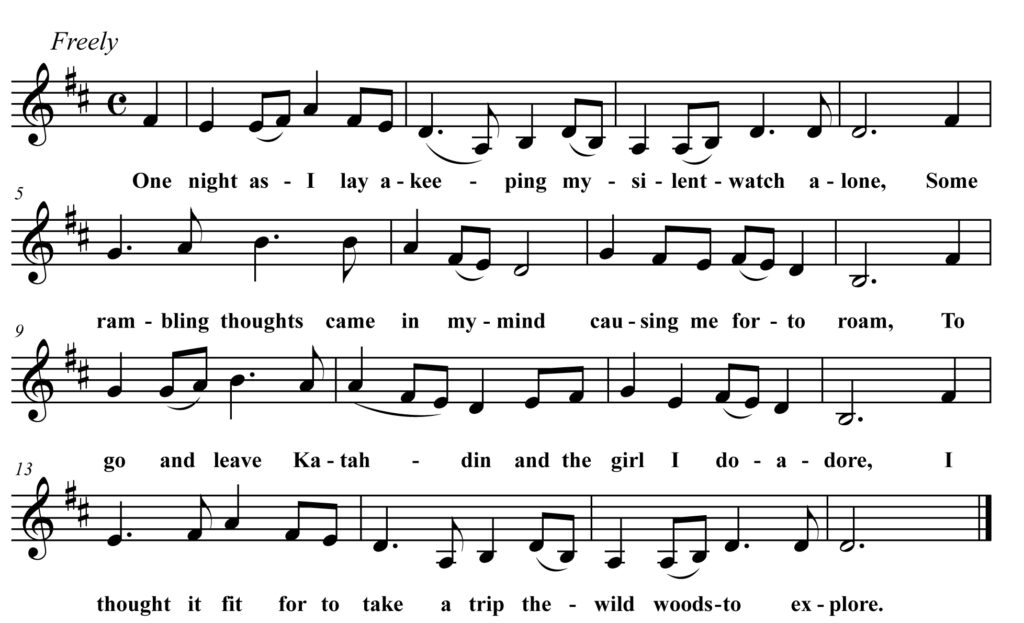
One night as I lay a-keeping my silent watch alone,
Some rambling thoughts came in my mind, causing me for to roam,
To go and leave Katahdin and the girl I do adore,
I thought it fit for to take a trip, the wild woods to explore.

I took my true love by the hand and to help her I did say,
“My train it leaves tomorrow, my dear I must away,
But as we gently glide along, we will cause every tavern to roar,
Drinking health to old Katahdin and the girls we do adore.”

Katahdin it’s a pretty place with pretty girls therein,
You’d think that they were nightingales, were you to hear them sing,
And little lambs they sport and play all by their mother’s side,
And the salmon, trout and pickerel in the streams do gently glide.

When I arrived in Sancook the people gathered round,
They said I wasn’t able, the tall pine to cut down,
But I could hire as a cookee if I kept snug and clean,
Well, that was the very first time that I missed Katahdin green.

Well, the winter is now over, and the teams, they’re coming out,
Our boss he calls the men to him to hire them for the route,
“It is to those who will stay here, high wages I’ll pay to ye,
And when the lumber is in Old Town you routers may go free.”

My hand it’s growing tired, no more can I pen down,
I hope our boss’s lumber arrives safe in Old Town,
And when we get to Bangor, we will cause every tavern to roar,
Drinking health to old Katahdin and the girls we do adore.

The Penobscot word for “great mountain” gives us the name Katahdin for the tallest mountain in the state of Maine. In small towns like those near Mount Katahdin it was once common for teenaged boys to set out in the fall in search of winter employment in a live-in logging camp. Some such boys had fathers who came from the north of Ireland where seasonal work at harvest time in Scotland drew young men over the North Channel each year. This could explain why “Katahdin” seems to be a variant of the song known in the north of Ireland as “Brockagh Brae” or “The Roslea Farewell” (Roud 5171) that references the Ireland to Scotland work pattern.

I developed the above version based on that collected from Ambrose Herrell in Prince Edward Island and printed in Folksongs from Prince Edward Island by Randall and Dorothy Dibblee. I recorded it on the album Minnesota Lumberjack Songs and plan to release a new version with Danny Diamond on the upcoming Northern Shores album. The PEI version is still my favorite but I have since discovered interesting variants collected in Michigan, New Brunswick and West Virginia.

01 Sep

The Rose of Ardee

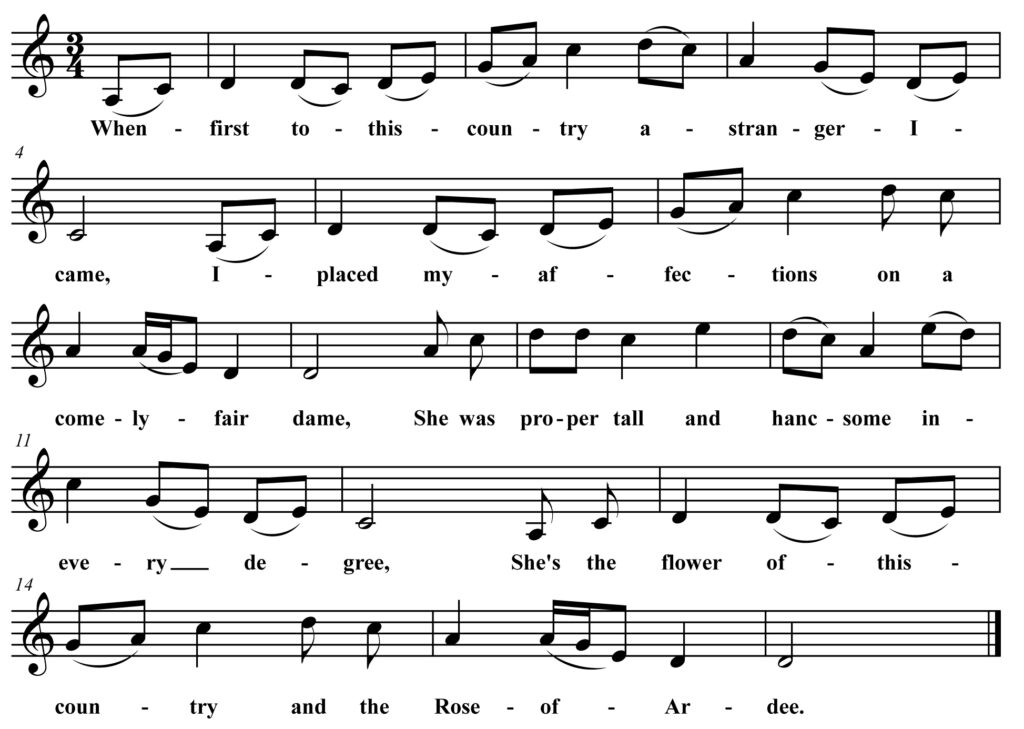
When first to this country a stranger I came,
I placed my affections on a comely fair dame,
She was proper, tall and handsome in every degree,
She’s the flower of this country and the Rose of Ardee.

I courted lovely Mary at the age of sixteen,
Her waist it was slender, her carriage genteel,
’Til at length a young weaver came there, her to see,
And stole the flower of the country, the Rose of Ardee.

My curse may it light on you, by day and by night,
You’ve fled with my true love, far, far from my sight,
And left me to mourn in a strange country,
For the loss of my darling the Rose of Ardee.

I’m bound to the city for months two or three,
And perhaps on my journey some pretty girl I’ll see,
In a short space of time she may prove kind to me,
But I never can forget the sweet Rose of Ardee.

When I get my week’s wages to the ale house I’ll go,
And there I’ll sit drinking with my heart full of woe,
I’ll sit there lamenting, expecting to see,
Once more my own true love, the Rose of Ardee.

I swear, lovely Mary, by the powers above,
Though inconstant you’ve been, I no other can love,
Oh if we could meet my sweet bride you should be,
And I should be blest with the Rose of Ardee.

Oh, lovely Mary you have been severe,
To slight your own true love that loved you so dear,
I must weep in despair until death I do see,
For the loss of my darling the Rose of Ardee.

Farewell lovely Mary though fled from my sight,
For you I am weeping by day and by night,
But I fear my sweet angel, I never shall see,
So adieu evermore to the Rose of Ardee.

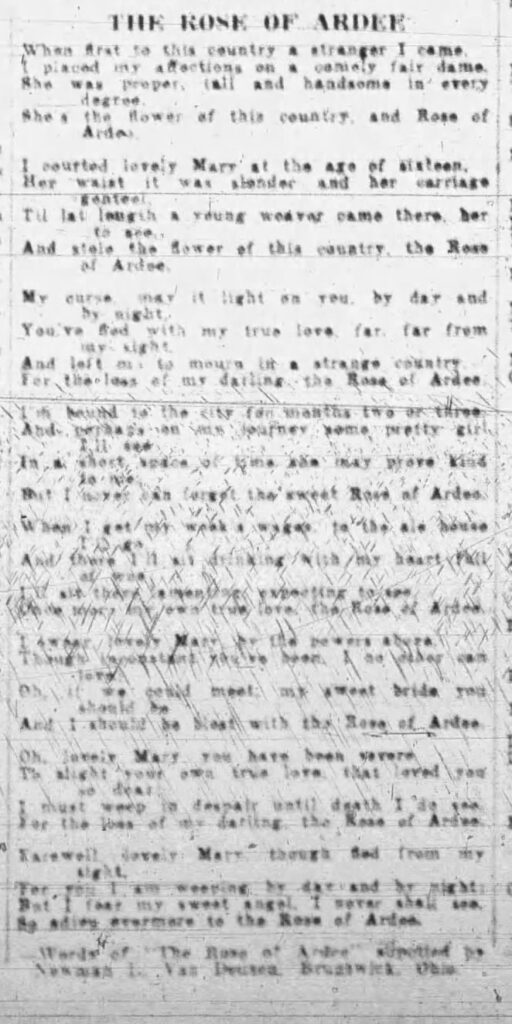
The “Old Songs Exchange” column that ran in the Minneapolis Journal from October 1923 to January 1925 drew many active readers/correspondents from outside Minnesota.  Newman Van Deusen/Dusen of Brunswick, Ohio may have contributed the words to last month’s song “My Emmett’s No More.” On October 5, 1924, the column ran Van Dusen’s request for the words to “The Rose of Ardee.” Curiously, Newman Van Deusen of Brunswick, Ohio is credited with sending in the words to the song when they were published on November 9, 1924.

It could be that Van Deusen found the text in a songster. His lengthy version closely matches (though not exactly) that printed by Henry De Marsan in New York in the 1868 New Comic and Sentimental Singer’s Journal. A much shorter, fragmentary text for the song appears in a western New York family songbook (circa 1841-1856) published by Harold W. Thompson as A Pioneer Songster so it does seem plausible that the song made it in to tradition in the Lakes states.

“The Rose of Ardee” is sung in the north of Ireland and I have married the Minneapolis Journal text to the air used by Desi Wilkinson on his album The Three Piece Flute.

“The Rose of Ardee” as it appears in the 11/09/1924 “Old Songs Exchangecolumn in the Minneapolis Journal