22 Jan

Young Sally Munroe (Laws K11)
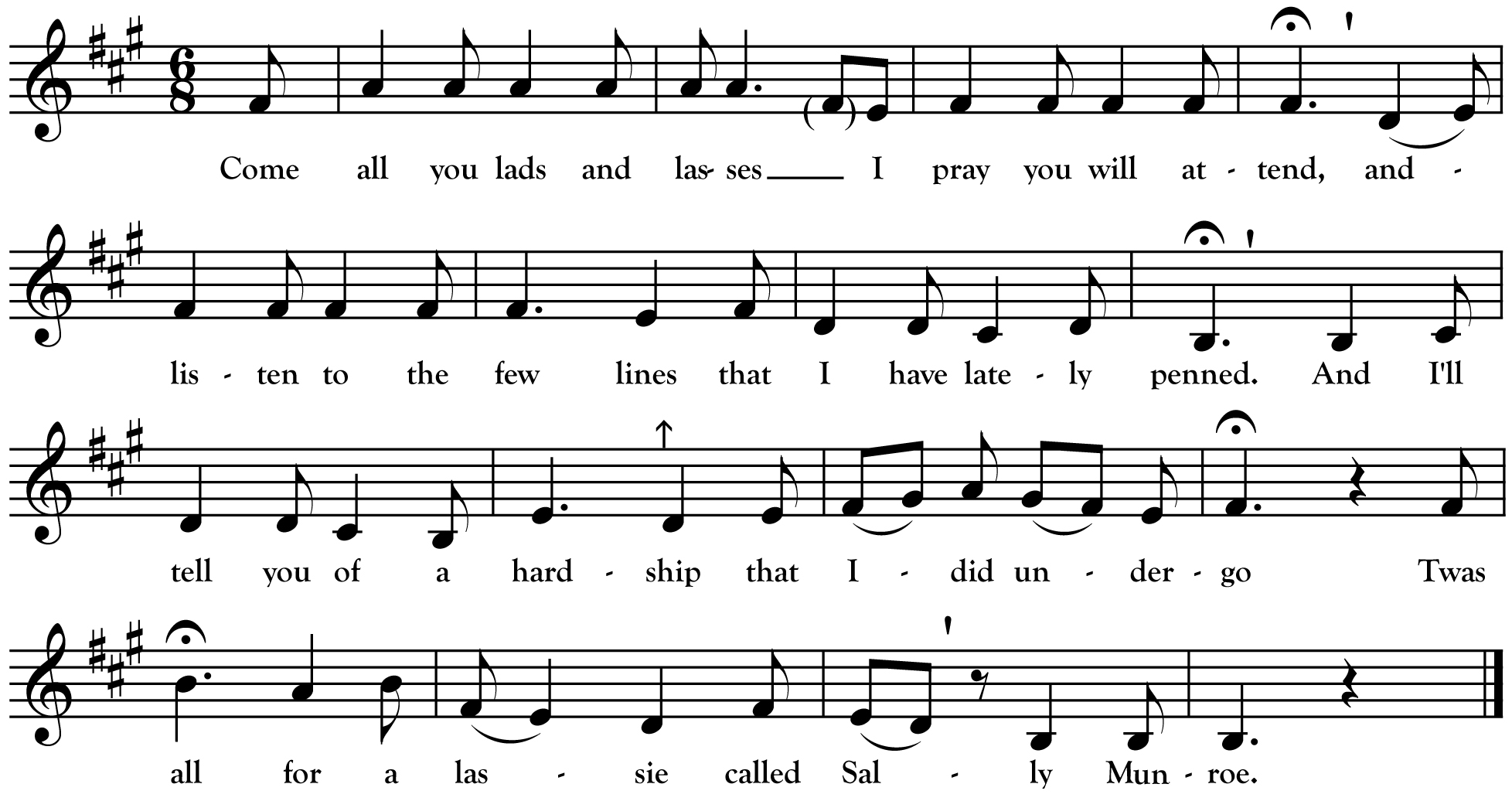
Young Sally Monroe


Come, all you lads and lassies, I pray you will attend,
And listen to these few lines that I have lately penned,
And I’ll tell you of the hardships that I did undergo,
’Twas all for a lassie called Sally Munroe.

My name it is Jim Dixon, I’m a blacksmith by trade,
And ’twas in the town of Erie where I was born and raised;
From that town to Belfast to work I did go,
A distance in the country from Sally Munroe.

But I promised that fair lady a letter I would send,
And I gave it to a comrade I took to be my friend,
But instead of being a friend of mine, he proved to be my foe,
For he never gave that letter to young Sally Munroe.

But he told her old mother for to beware of me,
That I had a wife in a strange country;
Then says her old mother, “If what you say be so,
He never shall enjoy my young Sally Munroe.”

It was two years and better and never did I hear
A word from the lassie that I once loved so dear,
Till one bright summer morning down by a shady row,
It was there I by chance did meet young Sally Munroe.

I says, “My bonnie lassie, if you’ll gang along wi’ me,
In spite of our auld parents it’s married we will be.”
She says, “I have no objections along with you to go,
For I know you will prove loyal to your Sally Munroe.”
It was in a coach from Norwich to Belfast we did go,
And there I was married to young Sally Munroe;

There was a ship at Williams’ Point all ready to set sail,
With five hundred passengers, their passage all were paid,
I paid down our passage for Quebec also,
And there I did embark with Sally Munroe.

We sailed down the river with a sweet and pleasant gale,
And left our old parents behind to weep and wail,
While many were the salt tears that down their cheeks did flow,
Oh, I was quite happy with young Sally Munroe.

About four in the morning came on a dreadful blow,
Our ship she struck a rock and to the bottom she did go,
With five hundred passengers that were all down below,
And among that great number I lost Sally Munroe.

It was from her old parents that I stole her away,
And that will shock my conscience for many a long day;
It was not for to injure her that ever I did so,
And I’ll mourn all my days for young Sally Munroe.
———————————————————————–

This month’s song is another for which I transcribed the melody from a 1924 wax cylinder recording of Minnesota singer Mike Dean. The text is, again, from Dean’s 1922 songster The Flying Cloud. The song is a rather rare one dating back to the 1830s when it was printed as a broadside (cheap song lyric sheets sold on the street by singers) in northern England and Scotland.* It was likely inspired by an actual event: the 1830 shipwreck of the ship “Newry” which sailed from Newry town with 400 Irish emigrants aboard bound for Quebec but wrecked off Bardsey Island near the Welsh coast where 100 perished. In some of those early broadside versions, Jim Dixon is born in Ayr, Scotland, goes to Belfast to work where he meets Sally and then sails from Newry but shipwrecks en route to Quebec.

The song crossed over to North America where it was collected mainly in Newfoundland and the Canadian Maritime Provinces. Place names vary between most versions. Dean’s version is special because it is the only one collected from a Great Lakes region singer. Also, the abundant place names in Dean’s might indicate it came from southeastern Ontario. Fort Erie, Belfast, Norwich and Williams’ Point are all places in that part of Canada.

This was an exciting one to hear on the recently rediscovered cylinder recordings! Dean has a very striking melody for the song which is different than any other I have found.

*For a detailed discussion of early printings of Sally Munro see Roly Brown’s article on Sally Munro
_________________________________________________

More detailed information on this song from the Traditional Ballad Index

30 Nov

The Falling of the Pine

Come, all young men a-wanting of courage bold undaunted,
Repair unto the shanties before your youth’s decline,
For spectators they will ponder and gaze on you with wonder,
For your noise exceeds the thunder in the falling of the pine.

The shanty is our station and lumbering our occupation,
Where each man has his station, some for to score and line,
It is nine foot of a block we will bust at every knock,
And the wolves and bears we’ll shock at the falling of the pine.

When the day it is a-breaking from our slumbers we’re awakened,
Breakfast being over, our axes we will grind,
Into the woods we do advance where our axes sharp do glance,
And like brothers we commence for to fall the stately pine.

For it’s to our work we go through the cold and stormy snow,
And it’s there we labor gayly till bright Phoebus does not shine;
Then to the shanties we’ll go in and songs of love we’ll sing,
And we’ll make the valleys ring at the falling of the pine.

When the weather it grows colder, like lions we’re more bolder,
And while this forms grief for others, it’s but the least of mine,
For the frost and snow so keen, it can never keep us in,
It can never keep us in from the falling of the pine.

When the snow is all diminished and our shanty work all finished,
Banished we are all for a little time,
And then far apart we’re scattered until the booms are gathered,
Until the booms are gathered into handsome rafts of pine.

When we get to Quebec, oh, me boys, we’ll not forget,
And our whistles we will wet with some brandy and good wine;
With fair maidens we will boast till our money is all used,
And, my boys, we’ll ne’er refuse to go back and fall the pine.

____________________________________________________

In 1922, Minnesota singer Mike Dean printed his version of this song (text only) in his songster The Flying Cloud along with the subtitle “Square Timber Logging.” The next year, he sang it for collector Franz Rickaby who transcribed Dean’s melody and noted the singer’s story behind the song. Dean said the song came from the Georgian Bay region of Ontario and dated back to a time (pre-1870) when “shanty boys” squared off the logs in the woods by axe* before binding them into rafts and driving them down river to Quebec City. From Quebec, the timber was often shipped out the St. Lawrence Seaway and over the ocean to Liverpool. Collectors who found other versions of The Falling of the Pine (in Maine, Pennsylvania, Michigan and Ontario) noted that it is likely one of the oldest songs to come out of the lumber camp tradition and that it may date to as early as 1825. A fragment collected in Ontario begins, interestingly, “your Irish hearts are wanton.”

The melody above comes not from Rickaby’s 1923 transcription but from my own 2012 transcription based on the recently discovered 1924 recording of Dean’s singing made by Robert Winslow Gordon. Dean’s melody on the Gordon recording is considerably different from Rickaby’s transcription taken down just 14 months previous! Part of the reason is likely some bias in Rickaby’s assumptions about what the “right” notes were. Dean’s singing on the Gordon recording also shows him using a lot of melodic variation between different performances of the same song (two songs were recorded twice on the Gordon cylinders) in addition to quite a bit of melodic variation between verses within songs—a hallmark of a great traditional singer.

Transcription note: Dean, like many traditional singers, makes occasional use of “in between” notes and I mark two of his slightly raised pitches with arrows in the above transcription.

*“Scoring” and “lining” were part of the squaring process.

_________________________________________________

More detailed information on this song from the Traditional Ballad Index
 

30 Nov

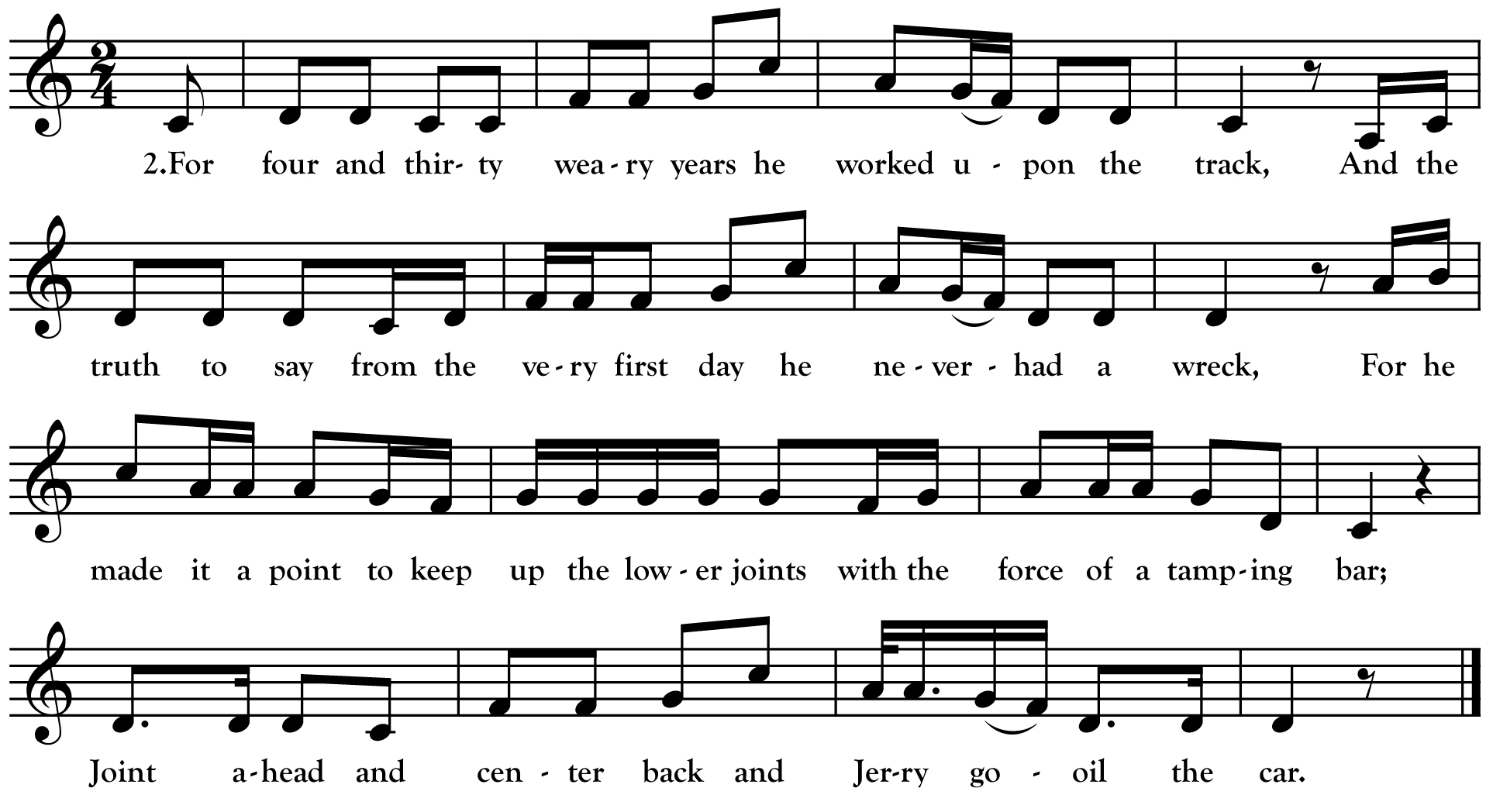
Jerry Go Oil the Car (Laws H30)

Come, all you railroad section hands, I hope you will draw near,
And likewise pay attention to these few lines you’ll hear,
Concerning one Larry Sullivan, alas, he is no more,
He sailed some forty years ago from the green old Irish shore.

For four and thirty weary years he worked upon the track,
And the truth to say from the very first day he never had a wreck,
For he made it a point to keep up the lower joints with the force of the tamping bar;
Joint ahead and center back and Jerry go oil the car.

To see old Larry in the winter time when the hills were clad with snow,
It was his pride on his handcar to ride as over the section he’d go,
With his big soldier coat buttoned up to his throat, sure he looked like an Emperor,
And while the boys were shimming up the ties, sure Jerry would be oiling the car.

When Sunday morning came around to the section hands he’d say,
“I suppose you all know that my wife is going to Mass today,
And I want every man for to pump all he can, for the distance it is very far,
And I’d like to get in ahead of number ten, so Jerry go oil the car.”

“And now when my friends are gathered around, there is one request I crave,
When I am dead and gone to my rest, place the handcar on my grave;
Let the spike mawl rest upon my breast with the gauge and the old clawbar,
And while the boys are lowering me down, lave Jerry to be oiling the car.”

“Give my regards to the roadmaster,” poor Larry he did cry,
“And rise me up so I may see the handcar before I die.”
He was so wake he could hardly spake, in a moment he was dead;
“Joint ahead and center back,” were the very last words he said.

Remarks by Mrs. Sullivan:

God bless you, Larry Sullivan, to me you was kind and good,
For me you’d make the section hands go out and cut the wood,
To the well also for water they would go, and chop the kindling fine,
And if any of them would growl, upon my soul, he’d dam soon get his time.

And now that he is dead I want it to be said that the cars they never got a jar;
Joint ahead and center back and Jerry go oil the car.

———————————————————————-

In his memoir about growing up in Cloquet, MN in the early 1900s, Walter O’Meara recalls stories told by his father Michael O’Meara, a life-long lumberman who was born in Ontario to Irish parents. One story concerns Scotty Boyle, a foreman on the Embarrass River:

In Scotty’s camp…the crew was not awakened, as in other camps, by the raucous notes of the long tin horn called the “gabrel.”  No indeed.  “Give ‘em Larry,” Scotty would say to a young Irishman on his crew, and the men were apprised of the dawn of a new day in the pines by the sweet strains of “Larry O’Sullivan.”[1]

Minnesota singer Mike Dean called the song by its other common name, “Jerry Go Oil the Car.” Above is the text from Dean’s songster The Flying Cloud including his own note that the last 1½ stanzas are the words of “Mrs. Sullivan.” The melody is as sung by Dean on a recently rediscovered 1924 wax cylinder recording made by Robert Winslow Gordon. Gordon recorded Dean’s first verse on one cylinder and then the 2nd and 3rd verses on a separate cylinder and the melody, though a version of “The Star of the County Down” in both cases, is considerably different between the two recordings. I give the verse 2 & 3 melody here. Gordon’s recordings show that Dean sang the song with a noticeable Irish brogue. He flips some Rs, oil becomes “ile” and emperor is “emporarr.”

Mike’s brother Charles Dean lived most of his life in the Twin Cities and, like millions of Irish-Americans across the US in the late 1800s, was a railroad worker for most of his life. Mike would have been quite familiar with railroad men himself as he ran a string of saloons and hotels across the street from the St. Paul and Duluth Depot in Hinckley, a common dinner stop for trains between St. Paul and Duluth.

[1] O’Meara, Walter. We Made it Through the Winter. St. Paul: Minnesota Historical Society, 1974,  p.10.

_________________________________________________

More detailed information on this song from the Traditional Ballad Index