02 Jun

The Banks of Brandywine
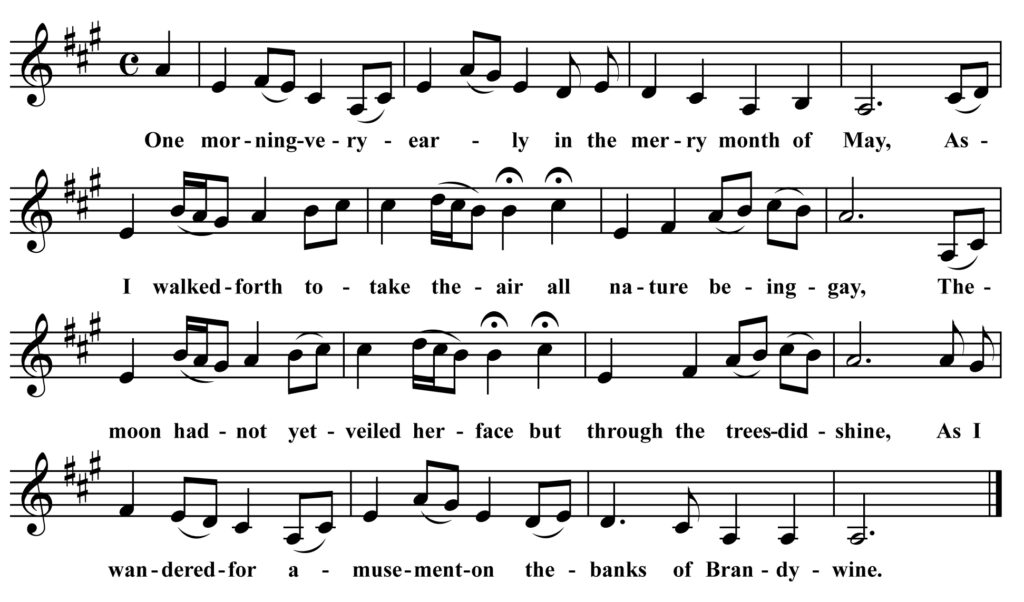
One morning very early in the merry month of May,
As I walked forth to take the air, all nature being gay,
The moon had not yet veiled her face but through the trees did shine,
As I wandered for amusement on the banks of Brandywine.

At such an early hour I was surprised to see,
A lovely maid with downcast eyes upon those banks so gay,
I modestly saluted her, she knew not my design,
And requested her sweet company, on the banks of Brandywine.

“O leave me sir do leave me my company forsake
For it is my real opinion you’re nothing but a rake,
My love’s a valiant sailor and he’s out on the brine,
While comfortless I wander on the banks of Brandywine.”

“My dear, why do you thus give up to melancholy cries?
I pray leave off your weeping, and dry those lovely eyes,
For sailors in each port, my dear, they do a mistress find,
He will leave you still to wander on the banks of Brandywine.”

“O leave me, sir, do leave me, why do you me torment?
My Henry won’t deceive me, therefore I am content,
Why do you thus torment me, and cruelly combine,
To fill my heart with horror on the banks of Brandywine?”

“I wish not to affect your mind but rather for to ease,
Such dreadful apprehensions that soon your mind will see,
Your love, my dear, in wedlock bands, another one has joined.”
She swooned into my arms on the banks of Brandywine.

O the lofty hills and craggy rocks re-echoed back her strain,
And the pleasant groves and rural shades gave witness to her pain,
“How often has he promised me in Hymen’s chains to join,
Now I’m a maid forsaken on the banks of Brandywine.”

“O no, my dear, that ne’er shall be, behold your Henry now,
I clasp you to my bosom, love, I have not forgot my vow,
It’s now I know you’re true, my dear, in Hymen’s chains we’ll join
And hail the happy morn we met on the banks of Brandywine.”

We return to the deep well of beautiful songs recorded by collector Helen Creighton in the Canadian Maritimes this month. While browsing around the recently accessible audio collection at the Nova Scotia Archives site I came across this one from singer Berton Young of West Petpeswick, Nova Scotia. Creighton recorded him in 1945.

This song appears in Creighton’s book Folk Songs of Nova Scotia in a slightly different form but I made my own transcription of Young’s singing here.  He has trouble remember the words so the recording jumps around a bit but he is another singer from that region who exhibits a fantastic light, ornamented style full of interesting twists and turns. The story is a classic example of a “Riley Ballad” where the returned lover disguises himself and tests the woman’s faithfulness before revealing his identity.

The Brandywine River (creek) referenced is most likely the one in Pennsylvania/Delaware that was the site of an important battle in the American Revolutionary War. That place name points to a North American origin for the song but it does turn up in Ireland as well. Irish song authority John Moulden guesses that it came back with someone who returned to Ireland after working over here.
17 Feb

Once I Had a Girl

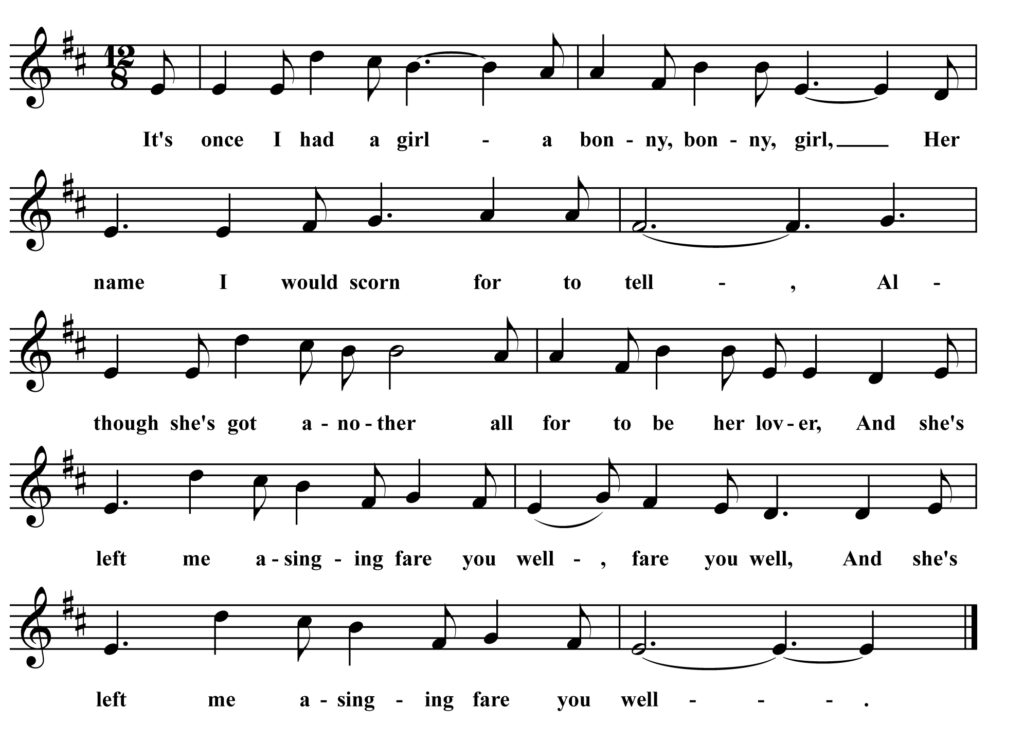
It’s once I had a girl, a bonny, bonny girl,
Her name I would scorn for to tell,
Although she’s got another all for to be her lover,
And she’s left me a-singing fare you well, fare you well,
And she’s left me a-singing fare you well.

As I walked out the Donnybrook side,
Near by the pine trees dwell,
It’s there I saw my girl, my bonny, bonny girl,
She was clasped in another man’s arms, arms, arms,
She was clasped in another man’s arms.

She reached out to me her lily white hand,
Just as if I was at her command,
Oh I soon passed her by, I ne’er cast an eye,
I was scorned to be slighted a girl, girl, girl,
I was scorned to be slighted by a girl.

Although my love is good, and just as good as she,
Although she has houses and land,
Of sweethearts I have plenty, I can count them out by twenty,
I can turn, I can change like the wind, wind, wind,
I can turn, I can change like the wind.

The above was sung by Mr. Sydney Boutilier of French Village, Nova Scotia for Helen Creighton’s recording machine in 1950. Creighton called it a “very pretty little love song” but, as far as I can tell, did not publish it in any of her folk song collections. It seems to be a rare song in tradition but I agree with Creighton that the melody is nice! I found this one among the many gems now available online through the Nova Scotia Archives at archives.novascotia.ca.

10 Dec

Come All Ye Old Comrades

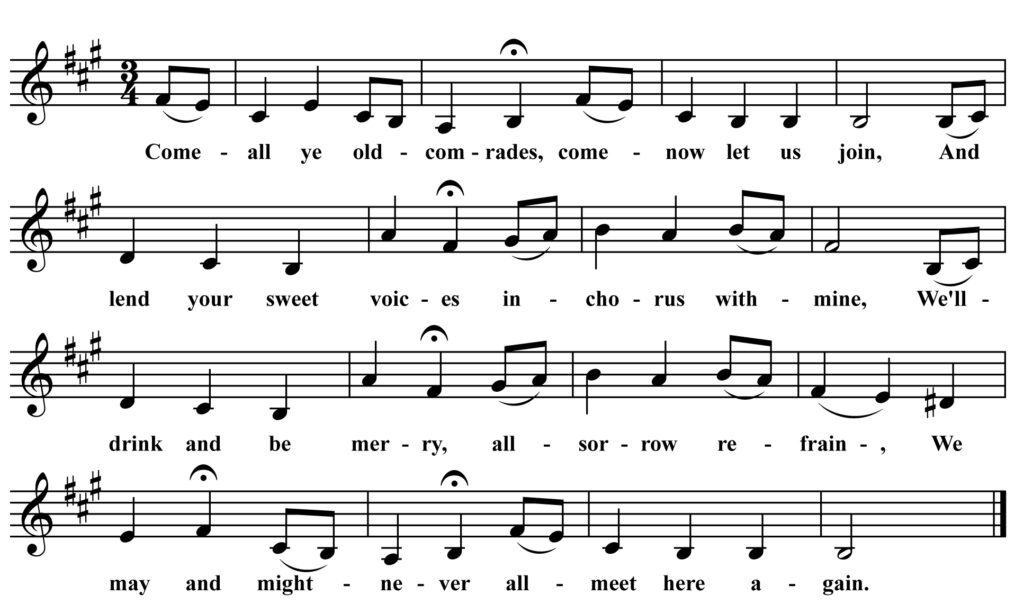
Come all ye old comrades, come now let us join,
And lend your sweet voices in chorus with mine,
We’ll drink and be merry, all sorrow refrain,
We may and may never all meet here again.

The time is fast approaching when I must away,
To leave my own country for many a long day,
To leave my old comrades so kind and so dear,
I to the Indies my course I must steer.


Fare thee well, I have a mother by the great powers above,
May she always be honored, respected and loved,
I will always respect her by land or by sea,
I’ll ever remember her kindness to me.

Fare thee well, I have a sweetheart whom I dearly love well,
There are none in this country who can her excel,
She smiles at my folly and she sits on my knee,
There’s few in this wide world as happy as we.

Adieu my old comrades, adieu and farewell,
Whether we’ll ever meet again there is no tongue can tell,
We will trust to his mercy who can sink or can save,
To bring me safe over yon proud stormy wave.

We have another song recorded in the Canadian Maritimes by Helen Creighton this month.  Many readers will be familiar with Irish or Scottish versions of “Here’s a Health to the Company” aka “Kind Friends and Companions.” It is a well-loved song to close out a night of singing, complete with sing-along chorus.

The above variant, which has no chorus, comes from the singing of Catherine Marion Scott Gallagher (Mrs. Edward Gallagher in Creighton’s notes) who lived at the Chebucto Head lighthouse south east of Halifax, Nova Scotia and was recorded by Creighton in 1949. You can hear Gallagher sing “Come All Ye Old Comrades” on the Nova Scotia Archives website.

Creighton printed another Nova Scotia variant of the song in the book Songs and Ballads from Nova Scotia but, as far as I can tell, the beautiful Gallagher version was not published until the release of this online archive. Gallagher’s phrasing on the recording is really nice and worth a listen for anyone interested in learning this one. The text and melody are also fairly unique from Irish/Scottish versions I am aware of. A great North American version of a favorite song!

.