16 May

Drummond’s Land

Drummond's Land

At the foot of David’s mountains where the waters they run calm,
And purling streams do gently glide down by my father’s land,
All covered o’er with a linen cloth that was wrought near Tendersgay*
And was purchased by one Kinnedy*, a man of high degree.

As I roved out one morning all for to take the air,
I being a clever young man with a fusee in my hand,
I might have shot a score or more had I but known my fate,
For my name is McCallum from the falls, and you know my fortune’s great.

As I roved out one evening down by the watchman’s dam,
The Belleville coach came rolling in all loaded to the ground,
[I put my spyglass to my eye, I viewed it all around]
And in one of the front seats sat a lady of renown.

I boldly stepped up to her for to help her from the coach,
I took her by the lily-white hand as we stood on the beach.
I showed her all my father’s ships that were bound for Cheshire fair,
Saying, “Only for you, lady, I am sure I would be there.”

I says, “My pretty fair maid, will you come to yonder inn,
And there we’ll have a bottle of wine our joys for to begin.
For I have lost a diamond more precious far than gold.
And you are the one that found it, fair lady, I am told.”

“For the keeping of young men’s company, kind sir, I’m not exposed,
Nor yet am I a lady, although I wear fine clothes,
I am but a farmer’s daughter that dwells near Hamilton’s band*;
And for further information, I dwell on Drummond’s land.”

Oh, it’s “Kind and honored lady, won’t you take the coach with me,
And we’ll go down to Drummond’s land your father for to see.
Five thousand pound in ready gold to your father I’ll bestow,
And I’ll crown you queen of Drummond’s land this night before we go.”

“I am sorry for you, young man. Your suit must be denied,
For I’m already promised to be a young man’s bride,
For I’m already promised these seven long years and more.
He is but a linen weaver, the lad whom I adore.”

*These are all as printed in the Rickaby manuscript. Based on versions from Eddie Butcher and one printed in Sam Henry’s “Songs of the People” I sing “Tandragee” (Co. Armagh) in place of Tendersgay, “Kennedy” in place of Kinnedy, and “Hamiltonsbawn” (Co. Armagh) in place of Hamilton’s band.

**line missing in the Ross text. I used text from Eddie Butcher recording and Sam Henry published version.
_________________________________________________________

[the following has been edited due to mistakes and omissions in the print version that appeared in the May IMDA newsletter]

The text of this version of “Drummond’s Land” (aka “David’s Flowery Vale”) was sent by Andy Ross of Charlevoix, Michigan to collector Franz Rickaby in August 1922. Rickaby had met with Ross and transcribed his singing in 1921 and hoped to make it back to Charlevoix to get Ross’s melody for Drummond’s Land at a later date. Unfortunately, Rickaby’s failing health caused him to leave the Upper Midwest for good in 1923 and Ross’s melody was never obtained.

I have paired Ross’s text with a melody used for another version of “Drummond’s Land” that appears in Sam Henry’s wonderful Songs of the People.  There is a nice recording of Derry singer Eddie Butcher singing another version which you can hear at the Irish Traditional Music Archive website here. Yet another version was sung by Co. Antrim singer Robert Cinnamond which you can hear on the album Not a Word of No Surrender.

Cinnamond’s version holds the key to the song’s origin as the wealthy suitor’s name is there McCance (instead of McCallum as in Ross’ version). John McCance (1772-1835) was a wealthy landowner, politician and owner of linen operations whose large estate was, indeed, at the foot of Divis (not David’s) Mountain just west of Belfast in County Antrim.

Another version of this song’s text from the Lisburn Historical Society along with biographical info on John McCance.

More background on this song from the Traditional Ballad Index

15 Apr

Persian’s Crew (Laws D4)

(The version in the video is based on the one below but includes my own deviations which are, in part, on purpose and, in part, due to forgetfulness!)
Persian's Crew

Sad and dismal is the story that I will tell to you,
About the schooner Persia, her officers and crew;
They sank beneath the waters deep in life to rise no more,
Where wind and desolation sweeps Lake Huron’s rock bound shore.

They left Chicago on their lee, their songs they did resound,
Their hearts were filled with joy and glee, for they were homeward bound;
They little thought the sword of death would meet them on their way
And they so full of joy and life would in Lake Huron lay.

In mystery o’er their fate was sealed, they did collide, some say,
And that is all that will be revealed until the judgment day;
But when the angels take their stand to sweep these waters blue,
They will summon forth at Heaven’s command the Persian’s luckless crew.

No mother’s hand was there to soothe the brow’s distracted pain,
No gentle wife for to caress those cold lips once again;
No sister nor a lover dear or little ones to moan,
But in the deep alone they sleep, far from their friends and home.

Her captain, he is no more, he lost his precious life,
He sank down among Lake Huron’s waves, free from all mortal strife;
A barren coast now hides from view his manly, lifeless form,
And still in death is the heart so true that weathered many a storm.

There was Daniel Sullivan, her mate, with a heart as true and brave,
As ever was compelled by fate to fill a sailor’s grave;
Alas, he lost his noble life, poor Daniel is no more,
He met a sad, untimely end upon Lake Huron’s shore.

Oh, Daniel, Dan, your many friends mourn the fate that has on you frowned,
They look in vain for your return back to Oswego town;
They miss the love glance of your eye, your hand they’ll clasp no more,
For still in death you now do lie upon Lake Huron’s shore.

Her sailors’ names I did not know, excepting one or two,
Down in the deep they all did go, they were a luckless crew;
Not one escaped to land to clear the mystery o’er,
Or to lie adrift by Heaven’s command in lifeless form ashore.

Now around Presque Isle the sea birds scream their mournful notes along,
In chanting to the sad requiem, the mournful funeral song,
They skim along the waters blue and then aloft they soar,
O’er the bodies of the Persian’s crew that lie along the shore.
______________________________________________________

We are back to the repertoire of Minnesota singer Michael Cassius Dean this month with the second of two Great Lakes shipwreck songs (see N.S. Feb. 2013 for the other) recorded from Dean by folklorist Robert Winslow Gordon in 1924. As usual, the text is from Dean’s songster The Flying Cloud and the melody is my transcription of the Gordon recording.

The schooner Persian was headed from Chicago to its home port of Oswego, New York with a cargo of grain in the fall of 1869 when it was caught in a heavy storm just east of the Straits of Mackinac. The eight-man crew was never heard from again. The song began as a poem penned by Oswego man Patrick Fennel, a dear friend of the Persian’s first mate Daniel Sullivan. Fennel’s pen name was Shandy Maguire.[1] The melody used by Dean and other Great Lakes sailors and lumbermen who set the poem to music was one used for many songs in the region. Dean himself used the same air for “As I Rode Down Through Irishtown” (see N.S. Mar. 2013).

Read more about this song on it’s Traditional Ballad Index page: http://www.fresnostate.edu/folklore/ballads/LD04.html


[1] Walton, Ivan H. / Joe Grimm. Windjammers: Songs of the Great Lakes Sailors. Detroit: Wayne State Univ. Pr., 2002, p. 191.

26 Mar

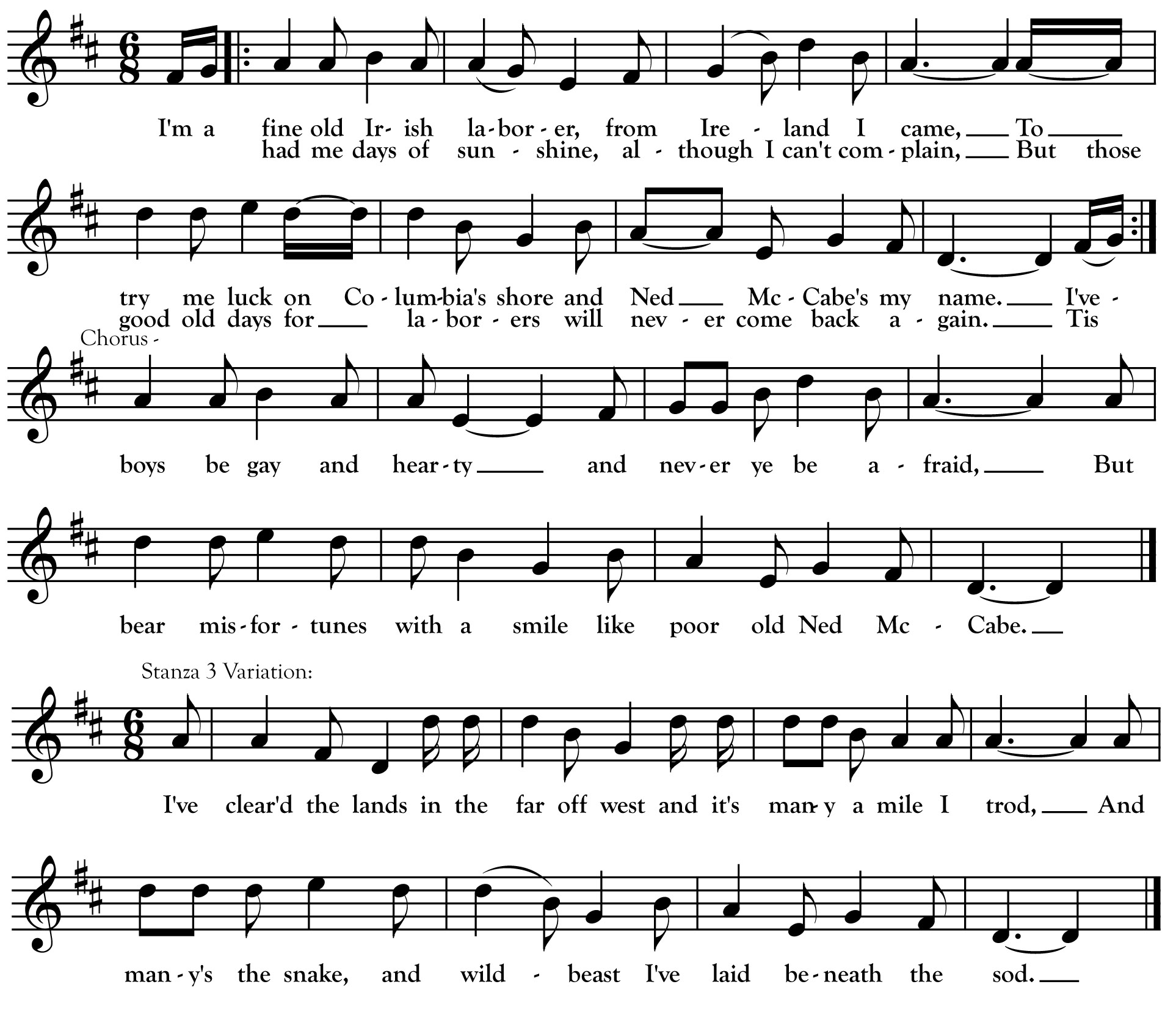
Ned McCabe

Ned McCabe

I’m a fine old Irish laborer, from Ireland I came,
To try me luck on Columbia’s shore, and Ned McCabe’s my name.
I’ve had me days of sunshine, although I can’t complain,
But those good old days for laborers will never come back again.

Chorus:
’Tis boys, be gay and hearty, and never ye be afraid,
But bear misfortunes with a smile like poor old Ned McCabe

But when I landed in Quebec, I had nary a red at all,
I hired out to a contractor, boys, to work upon a canawl.
I’d eighty cents a day, me boys, and whiskey too had I,
But when I think of those good old days, it almost makes me cry.   Chorus

*I’ve cleared the lands in the far-off west, and many a mile I’ve trod,
And many’s the snake, and wild beast, I’ve laid beneath the sod.    Chorus

Now the winter time is coming on, and away down south I’ll go,
To secure myself a winter’s job away from frost and snow.
Old Canady being by favorite whenever there I went,
I could drink my twenty jiggers a day and never step off o’ the plank.    Chorus

_________________________________________________________

Folk song collector Franz Rickaby made the above transcription of this very rare song from the singing of George Hankins (1849-1934) of Gordon, Wisconsin in the early 1920s. Earlier in his life, Hankins worked as a lumberjack and railroad man in Minnesota before making his home in Gordon, about 45 miles southeast of Duluth. Hankins told Rickaby that he learned the song when he first came to live in Wisconsin.

The song itself illustrates a familiar storyline for the first Irishmen to come to Minnesota and Wisconsin. It was common for Famine-era immigrants who sailed to Canada to find work as lumberjacks, railroad men, Great Lakes sailors or canal workers. Many of these men and their sons followed those jobs, or sometimes seasonal farm work, over the border into the US. So it was with many of the men who built Stillwater, Minnesota and other St. Croix Valley towns.


*I took some liberty with the words of this verse in what I published in the IMDA newsletter and in what I sing myself.  The original as transcribed by Rickaby reads:

I’ve cleared the lands in the far-off west where no white man ever trod,
And many’s the snake, and red man too, I’ve laid beneath the sod.