16 May

Drummond’s Land

Drummond's Land

At the foot of David’s mountains where the waters they run calm,
And purling streams do gently glide down by my father’s land,
All covered o’er with a linen cloth that was wrought near Tendersgay*
And was purchased by one Kinnedy*, a man of high degree.

As I roved out one morning all for to take the air,
I being a clever young man with a fusee in my hand,
I might have shot a score or more had I but known my fate,
For my name is McCallum from the falls, and you know my fortune’s great.

As I roved out one evening down by the watchman’s dam,
The Belleville coach came rolling in all loaded to the ground,
[I put my spyglass to my eye, I viewed it all around]
And in one of the front seats sat a lady of renown.

I boldly stepped up to her for to help her from the coach,
I took her by the lily-white hand as we stood on the beach.
I showed her all my father’s ships that were bound for Cheshire fair,
Saying, “Only for you, lady, I am sure I would be there.”

I says, “My pretty fair maid, will you come to yonder inn,
And there we’ll have a bottle of wine our joys for to begin.
For I have lost a diamond more precious far than gold.
And you are the one that found it, fair lady, I am told.”

“For the keeping of young men’s company, kind sir, I’m not exposed,
Nor yet am I a lady, although I wear fine clothes,
I am but a farmer’s daughter that dwells near Hamilton’s band*;
And for further information, I dwell on Drummond’s land.”

Oh, it’s “Kind and honored lady, won’t you take the coach with me,
And we’ll go down to Drummond’s land your father for to see.
Five thousand pound in ready gold to your father I’ll bestow,
And I’ll crown you queen of Drummond’s land this night before we go.”

“I am sorry for you, young man. Your suit must be denied,
For I’m already promised to be a young man’s bride,
For I’m already promised these seven long years and more.
He is but a linen weaver, the lad whom I adore.”

*These are all as printed in the Rickaby manuscript. Based on versions from Eddie Butcher and one printed in Sam Henry’s “Songs of the People” I sing “Tandragee” (Co. Armagh) in place of Tendersgay, “Kennedy” in place of Kinnedy, and “Hamiltonsbawn” (Co. Armagh) in place of Hamilton’s band.

**line missing in the Ross text. I used text from Eddie Butcher recording and Sam Henry published version.
_________________________________________________________

[the following has been edited due to mistakes and omissions in the print version that appeared in the May IMDA newsletter]

The text of this version of “Drummond’s Land” (aka “David’s Flowery Vale”) was sent by Andy Ross of Charlevoix, Michigan to collector Franz Rickaby in August 1922. Rickaby had met with Ross and transcribed his singing in 1921 and hoped to make it back to Charlevoix to get Ross’s melody for Drummond’s Land at a later date. Unfortunately, Rickaby’s failing health caused him to leave the Upper Midwest for good in 1923 and Ross’s melody was never obtained.

I have paired Ross’s text with a melody used for another version of “Drummond’s Land” that appears in Sam Henry’s wonderful Songs of the People.  There is a nice recording of Derry singer Eddie Butcher singing another version which you can hear at the Irish Traditional Music Archive website here. Yet another version was sung by Co. Antrim singer Robert Cinnamond which you can hear on the album Not a Word of No Surrender.

Cinnamond’s version holds the key to the song’s origin as the wealthy suitor’s name is there McCance (instead of McCallum as in Ross’ version). John McCance (1772-1835) was a wealthy landowner, politician and owner of linen operations whose large estate was, indeed, at the foot of Divis (not David’s) Mountain just west of Belfast in County Antrim.

Another version of this song’s text from the Lisburn Historical Society along with biographical info on John McCance.

More background on this song from the Traditional Ballad Index
26 Mar

Ned McCabe

Ned McCabe

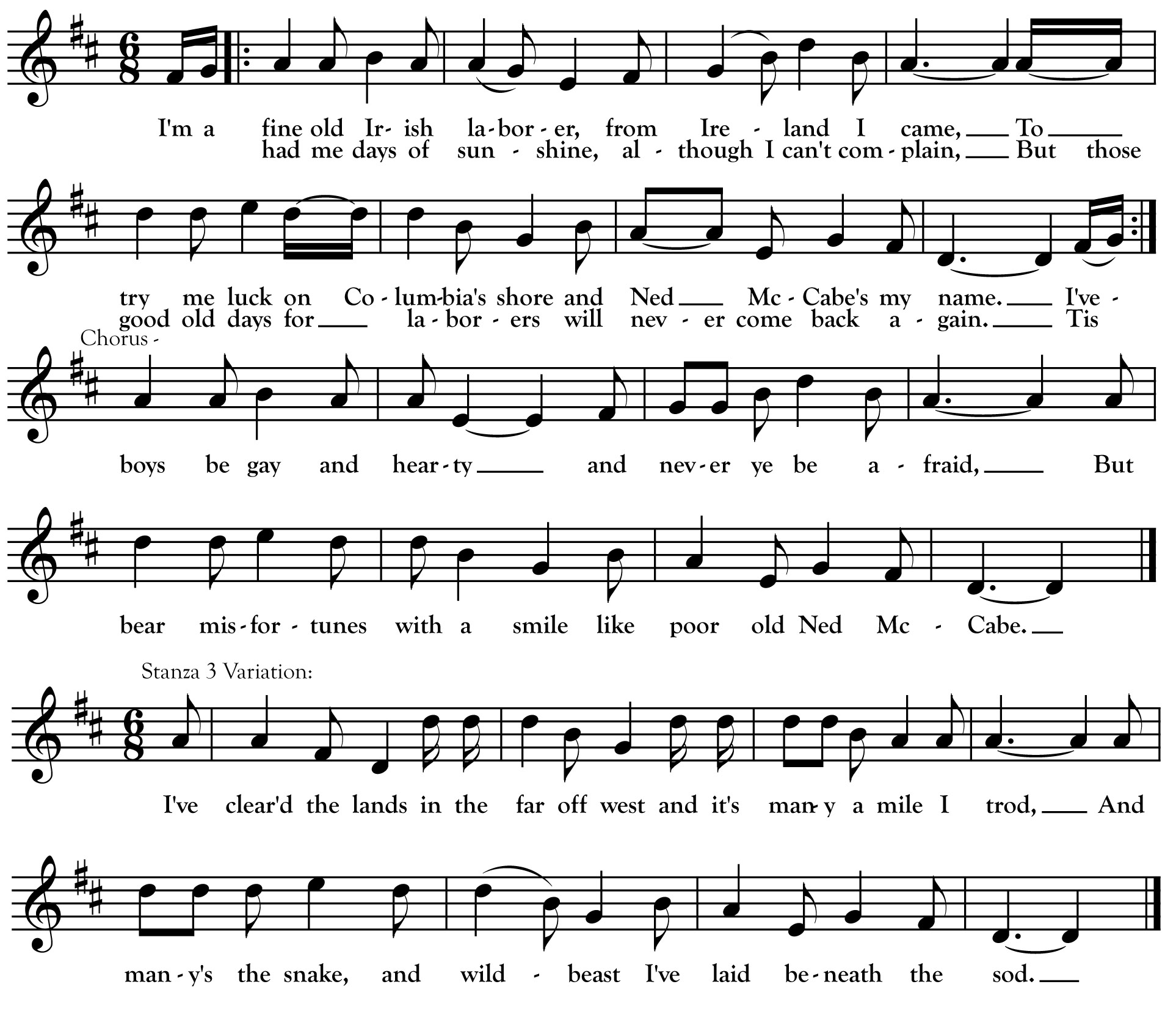
I’m a fine old Irish laborer, from Ireland I came,
To try me luck on Columbia’s shore, and Ned McCabe’s my name.
I’ve had me days of sunshine, although I can’t complain,
But those good old days for laborers will never come back again.

Chorus:
’Tis boys, be gay and hearty, and never ye be afraid,
But bear misfortunes with a smile like poor old Ned McCabe

But when I landed in Quebec, I had nary a red at all,
I hired out to a contractor, boys, to work upon a canawl.
I’d eighty cents a day, me boys, and whiskey too had I,
But when I think of those good old days, it almost makes me cry.   Chorus

*I’ve cleared the lands in the far-off west, and many a mile I’ve trod,
And many’s the snake, and wild beast, I’ve laid beneath the sod.    Chorus

Now the winter time is coming on, and away down south I’ll go,
To secure myself a winter’s job away from frost and snow.
Old Canady being by favorite whenever there I went,
I could drink my twenty jiggers a day and never step off o’ the plank.    Chorus

_________________________________________________________

Folk song collector Franz Rickaby made the above transcription of this very rare song from the singing of George Hankins (1849-1934) of Gordon, Wisconsin in the early 1920s. Earlier in his life, Hankins worked as a lumberjack and railroad man in Minnesota before making his home in Gordon, about 45 miles southeast of Duluth. Hankins told Rickaby that he learned the song when he first came to live in Wisconsin.

The song itself illustrates a familiar storyline for the first Irishmen to come to Minnesota and Wisconsin. It was common for Famine-era immigrants who sailed to Canada to find work as lumberjacks, railroad men, Great Lakes sailors or canal workers. Many of these men and their sons followed those jobs, or sometimes seasonal farm work, over the border into the US. So it was with many of the men who built Stillwater, Minnesota and other St. Croix Valley towns.


*I took some liberty with the words of this verse in what I published in the IMDA newsletter and in what I sing myself.  The original as transcribed by Rickaby reads:

I’ve cleared the lands in the far-off west where no white man ever trod,
And many’s the snake, and red man too, I’ve laid beneath the sod.


05 Dec

Banks of the Nile (Laws N9)

INTRODUCING: NORTHWOODS SONGS on YOUTUBE!

Starting this month, I will be videotaping myself singing the Northwoods Songs song of the month and posting it on Youtube.  I am excited to add this new dimension to the column!

Here I am singing Mike Dean’s “Banks of the Nile” while on vacation in the pines of beautiful Bowen Island, British Columbia last week. [Listening now, I realize I have considerably changed the first line of the melody on every verse but the first!  The many other variations and deviations are my own creative interpretation as well.]

Banks of the Nile


Hark! hark! the drums are beating, my love, I must away,
I hear the bugle calling, I can no longer stay;
We are ordered out from Portsmouth for many a long mile,
To *[join the British army] on the banks of the Nile.

Oh, Willie dear, don’t leave me here behind to weep and mourn,
So I may curse and rue the day that ever I was born,
For the parting from my sweetheart is like parting from my life,
So stay at home, dear Willie, and I will be your wife.

The Queen she calls for men, love, and I, for one, must go,
The Queen she calls for men, love, I dare not answer No;
We must away to face the foe while cannons roar the while,
To fight with Briton’s heroes on the banks of the Nile.

Then I’ll cut off my yellow hair and go along with you,
I will put on men’s clothing and go see Egypt, too;
I will cherish and protect you through hardship and through toil,
And we’ll comfort one another on the Banks of the Nile.

Your waist it is too slender, love, your fingers are too small,
I am afraid you would not answer when on you I would call,
Your delicate constitution would last but a short while,
Among those sandy deserts on the Banks of the Nile.

Oh, cursed be the cruel war and the hour it first begun,
For it has robbed old Ireland of many a noble son;
It robs us of our sweethearts, protectors of the soil,
And their bodies feed the wild fowls on the Banks of the Nile.

But soon the war will be over and we’ll all be coming home,
Unto our wives and sweethearts we left behind to mourn;
We will kiss them and embrace them with their little winning smile,
And we never will return again to the Banks of the Nile.

______________________________________________

Once again this month we have a song I transcribed from a 1924 recording of Minnesota-based singer Michael Cassius Dean (with the full text taken from Dean’s 1922 songster The Flying Cloud). Versions of “The Banks of the Nile” have been collected all over the English-speaking world. The scenario of the girl pledging to dress as a man to follow her love to war (or sea) will be well-known to anyone familiar with traditional folk song.

As for the historical context, there were several British campaigns in Egypt (and Sudan which is also bisected by the Nile) throughout the 1800s culminating in Britain’s takeover of Egypt in 1882. This song likely dates from early to mid 1800s. Of course, two centuries later, western governments are still sending soldiers to that part of the world and the “cruel war” is far from over.

*Some versions of  “The Banks of the Nile” mention the dark skin of the Eqyptian/Sudanese adversaries in the fourth line of the first stanza.  Dean’s version does so in a rather offensive way so I opted to borrow a variant fourth line from other versions.