02 Jun

New York Bay

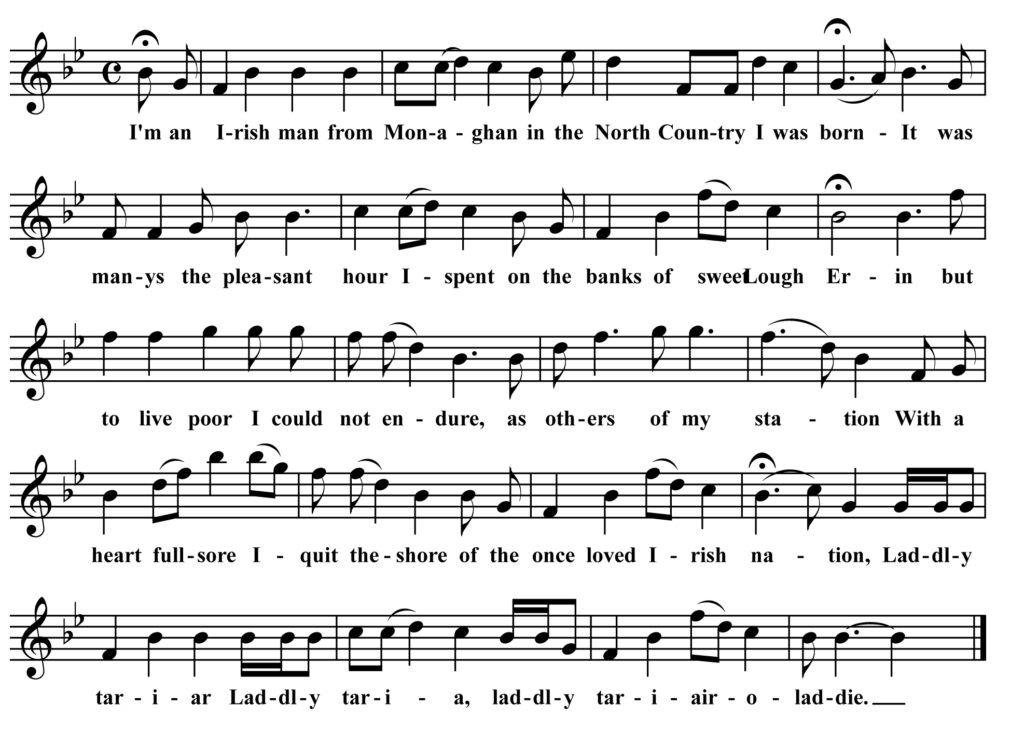
I’m an Irishman from Monaghan,
In the North Country I was born,
It was manys the pleasant hour I spent,
On the banks of Sweet Lough Erin,
But to live poor I could not endure,
As others in my station,
With a heart full sore, I quit the shore,
Of the once loved Irish nation.

CHORUS:
Laddly-tar-i-are, laddly-tar-i-a
Laddly-tar-i-air-o-laddie

It was early on one Sunday morn,
As Phebus was arising,
We set sail away for New York Bay,
In the stout brig call Elizie,*
And four or five of our best men,
When hunger was confounded,
And seven more jumped overboard,
And willfully was drowned.

And when we landed in New York Bay,
To see how they were dancing,
There were lads and lassies dancing around
And ’round each other prancing,
And each lass to see how she was dressed
With white petticoats and long flounces,
And linked with each lass there was a lad,
With blue jackets and white trousers.

And when we landed in New York Bay,
We were both stout and hearty,
We were ready for any emergency,
That’s how the police force started,
Then we gave three cheers for Ireland,
Where friends lay broken hearted,
And like a flock of sheep, we strayed away,
And from each other parted.

Max Hunter collected this wonderfully unique variant of the well-known “Rambling Irishman” song in 1961 from Bertha Lauderdale of Fayetteville, Arkansas. I heard it first from singer Julie Henigan when she visited St. Paul to sing at the Traditional Singers Club 20 years ago. Julie spent time with the Max Hunter collection and she says Bertha Lauderdale, learned her songs from her grandfather Thomas Alexander Mulvagh who “emigrated from County Monaghan to Canada in 1836, bringing with him songs of broadside origin.”

The verse about “how the police force started” draws on the familiar trope of the Irish-American policeman.

You can hear Bertha’s unique, drawn out singing style on the Max Hunter page of the Missouri State University website. Julie Henigan’s singing of the song can be found on the Eoin McKiernan Library’s site in the Traditional Singers Club digital archive.

*Lauderdale inserts the chorus after every four lines starting here.
01 Mar

Farewell to Nancy

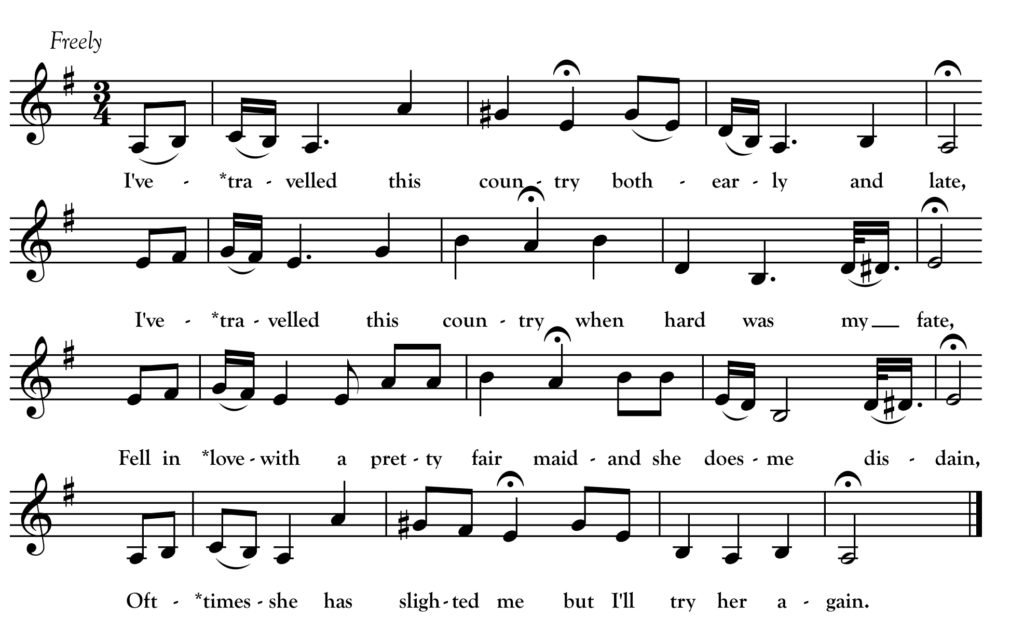
*my source singer for this transcription, Carrie Grover, varies her pitch selection on the asterisk-marked notes throughout her beautiful performance. Consult the online recording to get a feel for this and other aspects of her singing. A transcription can’t do it justice!

I’ve travelled this country both early and late,
I’ve travelled this country when hard was my fate,
Fell in love with a pretty fair maid, but she does me disdain,
Oft times she has slighted me, but I’ll try her again.

Oh, your parents are rich, love, and you hard to please,
I would have you take pity on your heart-broken slave,
I would have you leave your father and your mother also,
And through this wide world with your darling boy go.

“Oh, Johnnie, dear Johnnie, such advice will not do,
For leave my own country and to go along with you,
My friends and old sweethearts they would mourn my sad fate,
If I’d leave my own country and go follow a rake.”

Now my love she won’t have me, and away I must go,
To the wide spreading ocean where the salt breeze does blow,
To seek a companion, it is all my design,
Fare you well, dearest Nancy, must I leave you behind?

Fare you well, dearest Nancy, and merry may you be,
I will always think of you wherever you be,
But since you’ve proved unloyal to the one that’s so true,
May the wide spreading ocean separate I and you.

We return to the wonderful repertoire of Nova Scotia/Maine singer Carrie Grover this month for a song you can hear online via the Carrie Grover Project website. Grover’s singing is full of character and nuance and is definitely worth hearing. As I say above, the recording does a far better job of conveying her style than anything I can transcribe (or describe!) here.

Grover’s “Farewell to Nancy” contains some “floating” lines in the first verse that turn up in versions of other songs including “Green Grows the Laurel” and the Scottish Bothy ballad “Airlin’s Fine Braes.” Steve Roud classifies “Farewell to Nancy” along with a song called “Little Susie” that was sung in parts of the southern US. A version of “Little Susie” collected by Max Hunter in Arkansas does share many words with Grover’s song.

It is Carrie Grover’s striking melody that I find most attractive here. I love the big leaps and interesting pitch variances in her performance.