17 Feb

Doom on Superior

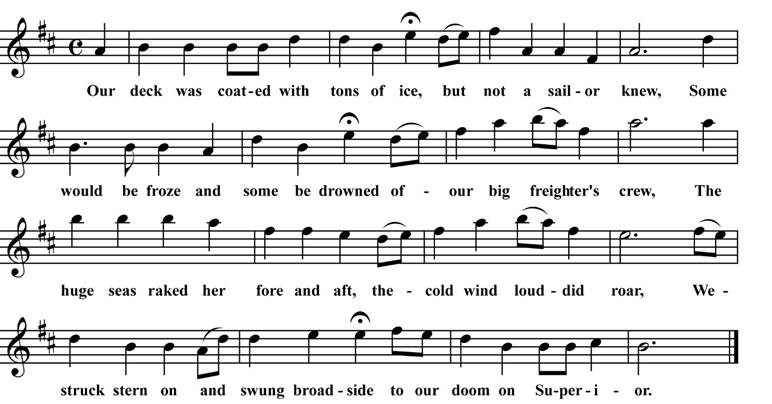
I am thinking of Lake Superior this month as I settle in to do music, along with the mighty Danny Diamond, for the play Whoosh! at the History Theatre in St. Paul. The Big Lake is a focus of the play (along with logging camps, the Civil War, Irish immigration and St. Anthony Falls) and, while looking for traditional songs relating to Lake Superior, I was reminded of this orphaned verse. The above text appears in William Ratigan’s 1960 book Great Lakes Shipwrecks & Survivals with this somewhat ambiguous note:

In its original form the ballad on the preceding page celebrated the loss of the vessel Antelope, presumably in Lake Michigan. Guesswork also fixes her as a schooner and the odds are in favor of the guess. There were thirteen Antelopes on the Lakes: seven schooners, two propellers, one brig, one scow, one barge, and one tug. They capsized and burned and foundered and were lost all over the various Lakes. But two of the schooners were wrecked on Lake Michigan in the year 1894, and therefore this date is applied to the song, which later became popular in the recital of other disasters, as shown in the adapted stanzas above.

Ratigan’s note seems to say that the verse was part of a localized variant of an earlier song about an Antelope that sank on Lake Michigan. The Lake Michigan song does exist and was documented by Ivan Walton and Edith Fowke who collected full versions of the song about Lake Michigan’s Antelope. I took the above melody from Fowke’s recording of “Skipper” Charles Henry Jeremy Snider of Toronto whose rendition appears on the Folkways album Songs of the Great Lakes. The book Songs of the Great Lakes Sailors by Walton and Grimm includes the Lake Superior verse as an addendum to an eight stanza version of the Lake Michigan song without giving a source for the fragment.

Ballad scholar Robert Waltz has theorized that the Lake Superior verse might refer to the 1897 wreck of the schooner Antelope off Michigan Island in the Apostle chain. That Antelope had been downgraded to a barge by the time it sank and no sailors were lost in the wreck so it’s not a perfect fit for the verse above.

So… it’s one to keep searching for! The verses from the Lake Michigan song could be reworked to go along with the Superior verse but I also hold out hope that the full Superior text must be out there somewhere. From Ratigan’s note, it could be that the Superior song was about a ship of a different name altogether. Stay tuned!
17 Feb

Jolly Raftsman

I am sixteen, I do confess, surely I’m no older-o,
I place my mind, it never shall move, it’s on a jolly raftsman-o.

Chorus:     To hew and score it is his plan and handle the broad axe neatly-o,
                  It’s lay a line and mark the pine and do it most completely-o.

My mother’s daily scolding me to marry some freeholder-o,
I place my mind, it never shall move, it’s on a jolly raftsman-o.
My love is marching through the pine as brave as Alexander-o,
None can I find to please my mind as well as a jolly raftsman-o.

And now he rides the rushing stream and smiles at all the danger-o,
I love the raft where my love laughs, my poor but jolly raftsman-o.
And now he leaps from log to log as light as any dancer-o,
And if my man would ask for my hand, I know what I would answer-o.

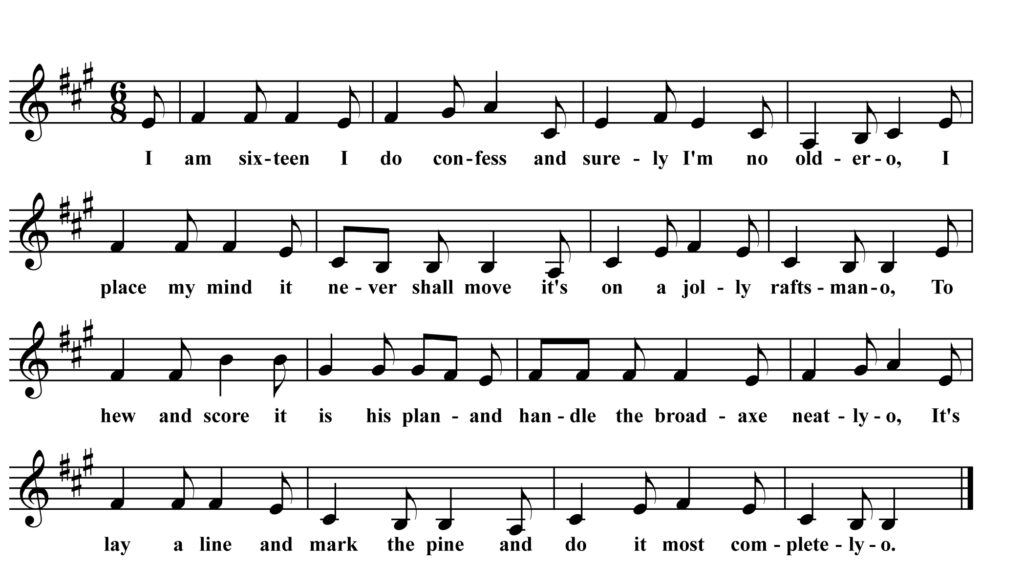
Prolific Canadian song catcher Edith Fowke recorded this song from the singing of Grace Fraser née MacDonald from Glengarry County, Ontario. Glengarry County is at the extreme eastern tip of southern Ontario and has a historically high concentration of highland Scots. Up until the end of the 20th century there were still locals who considered Scots Gaelic their native tongue. Mrs. Fraser learned it from her mother, Johanna MacDonald née McGillis who herself got it from her own lumberjack father Ranald McGillis.

The references hewing, scoring and laying “the line” reflect the square timber logging practice common when the industry first came to the Ontario woods. The girl’s confession that she is sixteen years old does not necessarily imply that she was younger than the object of her affection. It was common in those days for men to take their first lumbering job at the age of 14 or 15!

Mrs. Fraser only had the first three verses and chorus given above. I created the 4th and 5th verses myself with some inspiration from other Ontario songs about raftsmen. I put together this version 12 years ago and recorded it with Randy Gosa on the CD The Falling of the Pine.

23 Aug

Let No Man Steal Your Time

Come all young maids, so fair and gay,
That glory in your prime, [prime,]
Be wise, beware, keep your gardens clear,
Let no man steal your time, [let no man steal your time.]

For when your time it is all gone,
There’ll no man care for you,
And the very place where my time was,
Is spread all over with rue.

The gardener’s son was standing by,
Three flowers he plucked for me,
The pink, the blue, the violet, too,
And the red rosy three.

I’ll cut off the primrose top,
And plant a willow tree,
So that the whole world may plainly see,
How my love slighted me.

Slighted lovers they must live,
Although they live in pain,
For the grass that grows in yon green moor,
In time will rise again.

Roud No.: 3

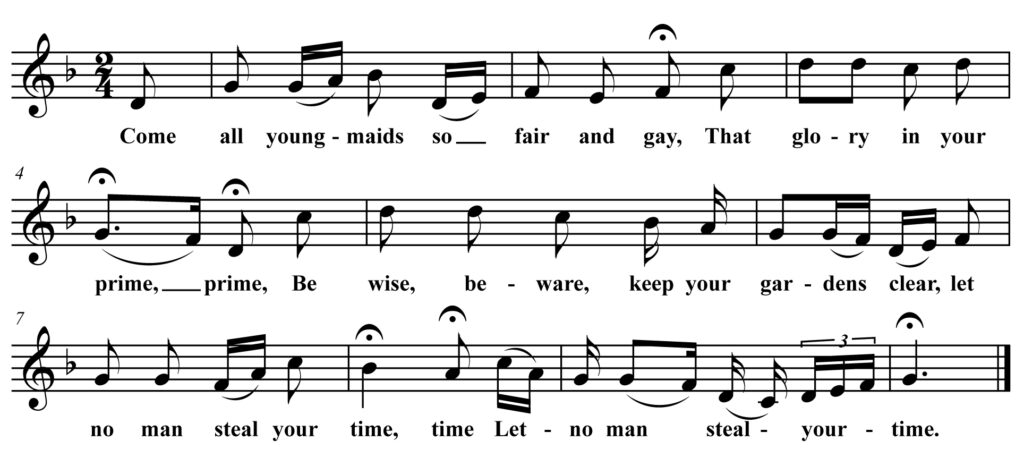
We have another traditional song this month that appears in the book Jim’s Western Gems compiled by Irish-Minnesotan singer James J. Somers and published in Minneapolis in 1912. Versions of the “Sprig of Thyme” date at least as far back as the 1760s in England and the song came to be sung widely in the English-speaking world. Above, I have married Somers’ text to the melody sung by Dublin singer Patrick Green in 1951 available through the Lomax Digital Archive website.

Somers titles this song text “The Last Song My Father Sang” which is likely a reference to his Irish-born father Martin Somers.

(Most printed versions highlight the double meaning of thyme/time by spelling it “thyme” but Somers’ book spells the word “time.” Somers’ text doesn’t indicate repeated words at the end of the 2nd or 4th lines but I’ve suggested them here to work with Patrick Green’s melody.)

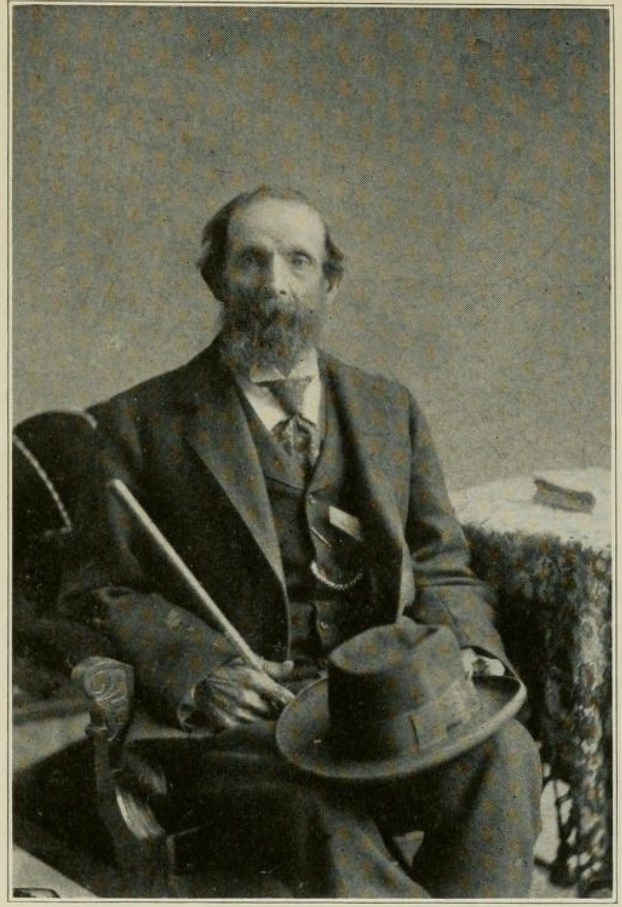
Martin Somers, father of James Somers, as pictured in Jim’s Western Gems. Martin was born in Ireland around 1831 and settled near Cardwell, Ontario, about 60km from the southern tip of Georgian Bay. Nearby placenames to Cardwell include many Irish references such as: Athlone, Achill, Ballycroy, Kilmanagh, Erin and Sligo.