10 Jul

Vandiemens Land (Laws L18)
Vandiemans Lande

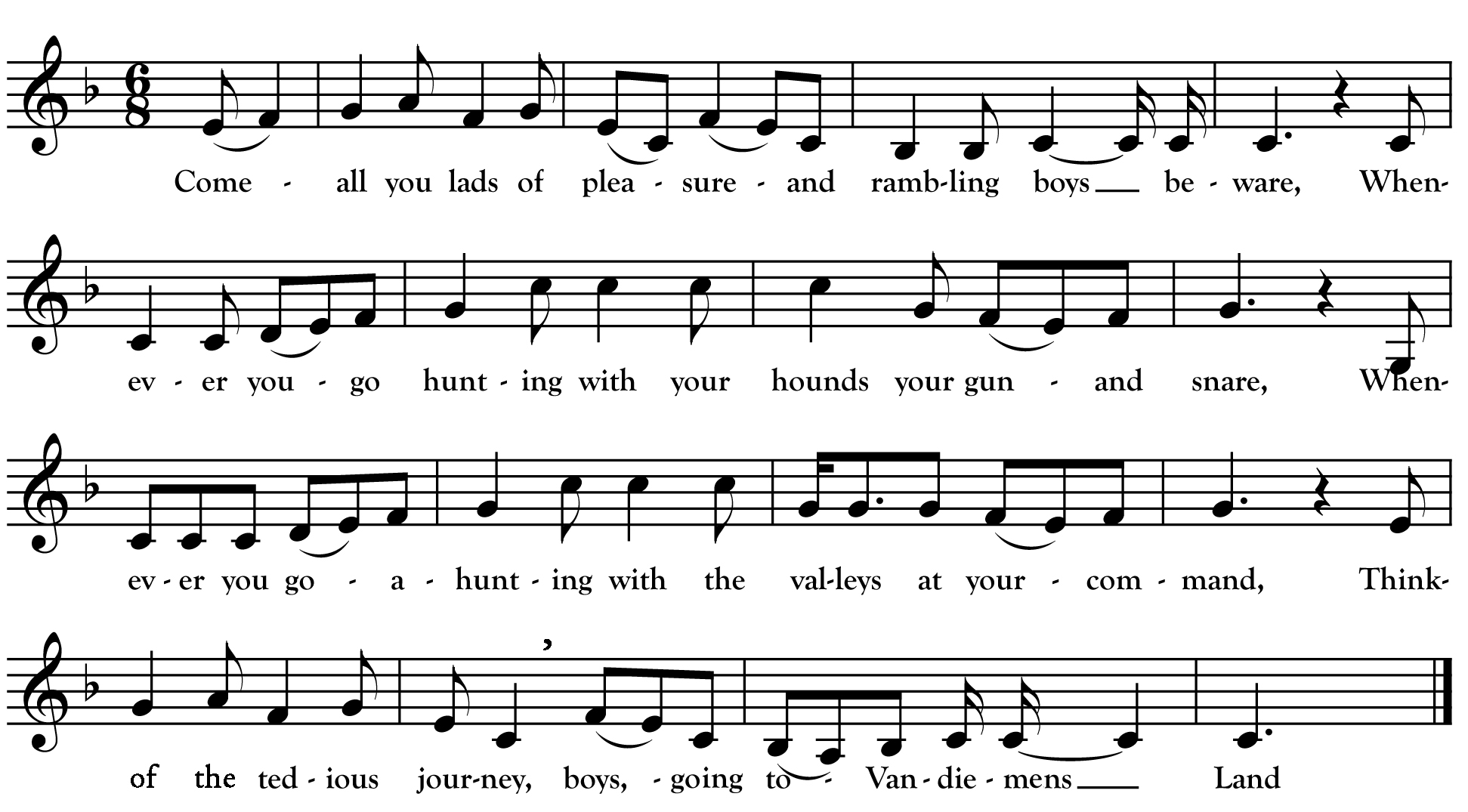
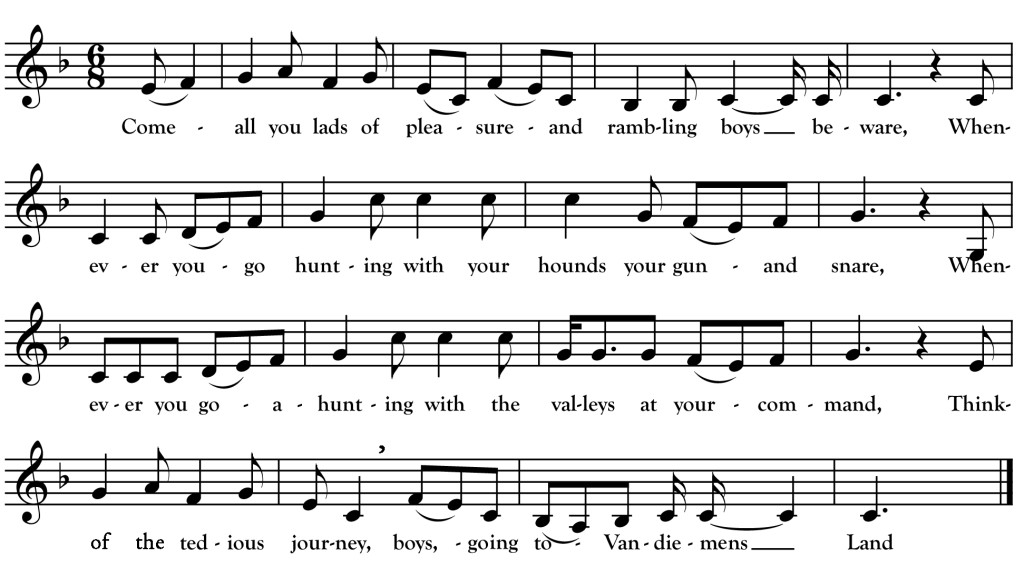
Come, all you lads of pleasure and rambling boys beware,
Whenever you go hunting with your hounds, your gun and snare,
Whenever you go a-hunting with the valleys at your command,
Think of the tedious journey, boys, going to Vandiemens Land.

There was Joe Brown from Nottingham, Jack Williams and Jack Jones,
They were three as jolly fellows, so well their country knows;
They were taken one night near the bay, all with their gun in hand,
And for fourteen years transported unto Vandiemens Land.

There was a girl from Nottingham, Sally Simons was her name,
For seven years transported for carrying on the game;
Our Captain bought her freedom and he married her off hand,
She gave us good usage going to Vandiemens Land.

The landing port we went to was on a foreign shore,
The planters they surrounded us, full a score or more,
They yoked us up like horses and sold us out off hand,
And they hitched us to the plow, me boys, to plow Vandiemens Land.

The houses that they built for us was made of sods and clay,
The beds we had to sleep on were made of rotten hay;
Oh, rotten hay for beds, me boys, and slumber if you can,
Oh, they gave us the very worst usage while on Vandiemens Land,

Last night as I lay down to sleep I had a pleasant dream,
I dreamt I was back in Ireland, down by a purling stream,
With my Irish girl beside me and her at my command,
But when I awoke my heart was broke, off on Vandiemens Land.
______________________________________________________

Anthony Van Diemen of the Dutch East India Company chartered an expedition led by explorer Abel Tasman resulting in the first European landing on land (later discovered to be an island) off the south-eastern coast of New South Wales (Australia) in 1642. The island, later renamed Tasmania, was colonized by the British in 1803 as a penal colony with the name Van Diemen’s Land. Convicts were sent to the island from that time until 1853.

Several traditional ballads mention punishment by transportation to Van Diemen’s Land. In this one, once prevalent in England, Scotland, Ireland, Australia and North America, the crime is poaching. This version, collected from Minnesotan singer Mike Dean, is from the point of view of a convicted Irishman though his criminal shipmates are poachers from Nottingham, England. Other versions tell of poachers apprehended in Ireland itself.

In the 1800s, the right to hunt in England and Ireland was limited to the aristocracy. Poaching was not the violation of animal protection laws it is today but rather an assault on the property of the wealthy who kept game on their lands. Poachers were usually people from the lower classes seeking food or money from the sale of wild game on the black market. Mike Dean was himself an avid hunter who made many trips around Minnesota and eastern South Dakota hunting prairie chickens while living in Hinckley in the late 1800s. It is interesting to imagine what this song meant to him as the son of Famine immigrants from County Mayo.

More detailed information on this song from the Traditional Ballad Index
31 Aug

The Day That I Played Baseball

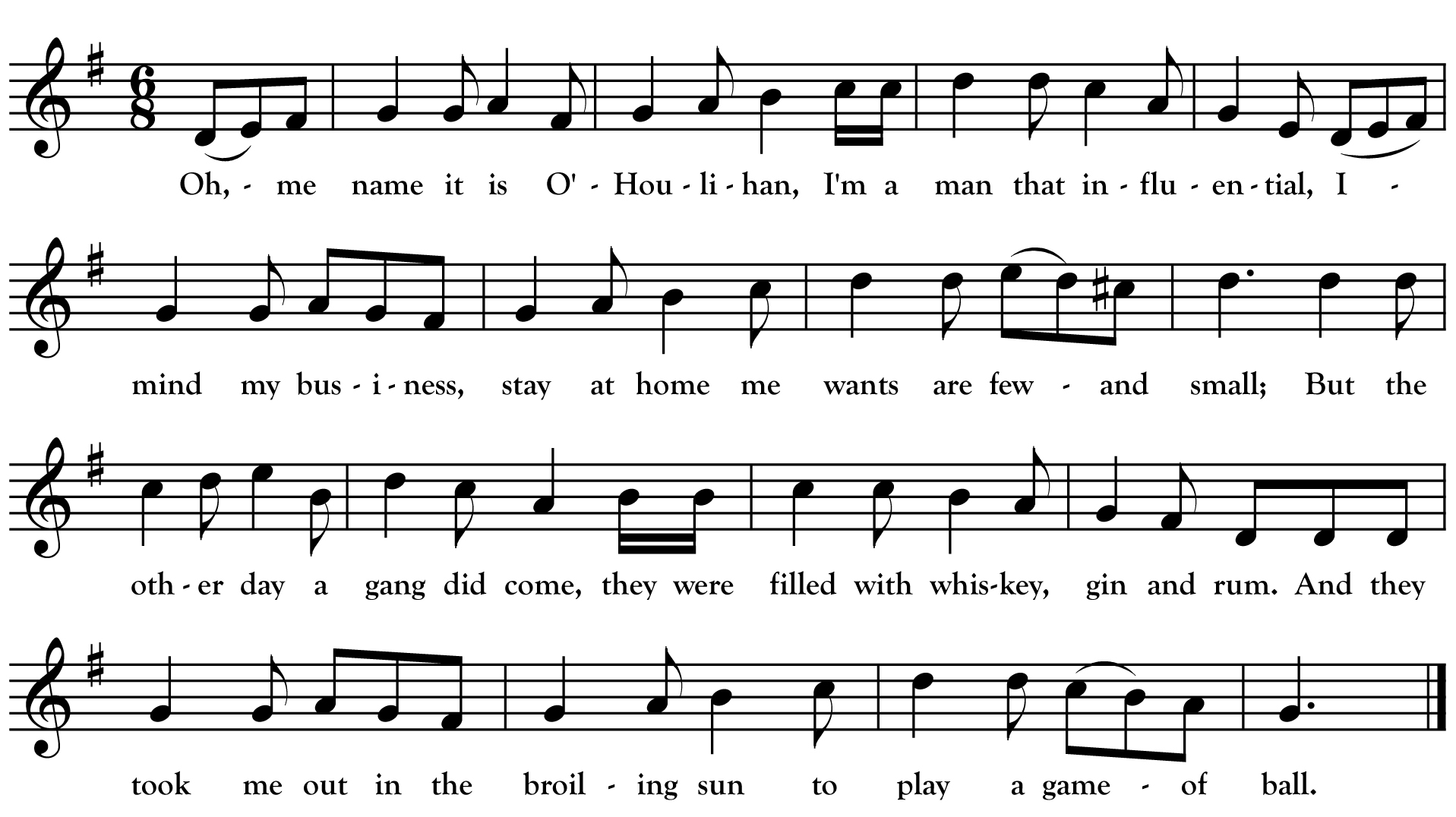
Oh, me name it is O’Houlihan, I’m a man that influential,
I mind my business stay at home me wants are few and small;
But the other day a gang did come, they were filled with whiskey, gin and rum.
And they took me out in the broiling sun to play a game of ball.

They made me carry all the bats, I thought they’d set me crazy,
They put me out in the center field, sure I paralyzed them all;
When I put up me hands to stop a fly, holy murther, it struck me in the eye,
And they laid me out by the fence to die on the day that I played baseball.

There was O’Shaughnessy of the second nine, he was throwing them underhanded,
He put a twirl upon them and I couldn’t strike them at all;
The umpire he called strikes on me; “What’s that?” says I, “You’re out,” says he,
Bad luck to you O’Shaughnessy, and the way that you twirled the ball.

Then I went to bat and I knocked the ball I thought to San Francisco,
Around the bases three times three, by Heavens, I run them all,
When the gang set up a terrible howl, saying, “O’Houlihan, you struck a foul,
And they rubbed me down with a Turkish towel on the day that I played baseball.

The catcher swore by the Jack of Trumps that he saw me stealing bases,
And fired me into a keg of beer, I loud for help did call;
I got roaring, staving, stone-blind drunk, I fell in the gutter, I lost my spunk,
I had a head on me like an elephant’s trunk on the day that I played baseball.

The reporters begged to know my name and presented me with a medal,
They asked me for my photograph to hang upon the wall;
Saying, “O’Houlihan you won the game,” though me head was sore and shoulder lame,
And they sent me home on a cattle train all the day that I played baseball.

____________________________________________________________

A seasonal selection from the repertoire of Mike Dean: Irish American lumberjack/saloon-keeper who lived in Minnesota from 1885-1931. Dean’s self-published songster The Flying Cloud contains many songs from the Irish-American music hall stage and this one falls squarely in that genre.

This song was written by Patrick James Rooney (1844-1892) in 1878. Rooney was a “clog dancer” who, along with his son, Pat Rooney Jr., had one of the most famous vaudeville song-and-dance men of his day. William H. A. Williams, in his book ’Twas Only an Irishman’s Dream writes: “In spite of moments of burlesque when he would sing ‘Biddy the Ballet Girl’ and  then clog around on his toes dressed in a tutu, Rooney was apparently a graceful dancer.” Irish performers like the Rooneys dominated American popular music in the late 1800s. “The Day I Played Baseball” was one of Pat Sr.’s few successful compositions. It was eventually overshadowed in 1908 by another baseball song in which “Katie Casey” begs her man: “Take Me Out to the Ball Game.”

In my search for information on Mike Dean’s life in Hinckley, Minnesota (1885-1908) I have found that baseball was wildly popular in Hinckley in the 1890s. Local papers in 1889 proclaimed a “baseball craze” in Hinckley and summer papers thereafter were filled with accounts of the exploits of the Hinckley Monarchs.

Interestingly, the sheet music I found for Rooney’s version of his own song (from which I took the above melody) only had four verses where Dean’s has six.  Perhaps Dean composed the verses (missing in the sheet music) about the ball-twirling O’Shaughnessy and the catcher’s intoxicating “punishment.” Maybe the added verses were even based on experience?
_____________________________________________________________

More on this song online:

Original sheet music for “The Day I Played Baseball” courtesy of the Library of Congress