07 Apr

Caroline of Edinburg Town (Laws P27)

Caroline of Edinburg Town


Come, all young men and maidens, come listen to my rhyme,
It is all about a nice young girl that was scarcely in her prime,
She beat the blushing roses, admired all around,
Was lovely little Caroline of Edinburg town.

Young Henry was a Highland man, a-courting her he came,
And when her parents came to know they did not like the same;
Young Henry was offended and this to her did say,
“Rise up, my lovely Caroline, and with me run away.”

Persuaded by young Henry, she put on her finest gown,
And soon was traveling on the road from Edinburg town;
She says to him, “Oh, Henry, dear, pray never on me frown,
Or you’ll break the heart of Caroline of Edinburg town.”

They had not been in London scarcely half a year
When hard-hearted Henry he proved to be severe;
Says Henry, “I’ll go to sea, your parents did on me frown,
So without delay go beg your way to Edinburg town.

The fleet is fitting out and to Spithead is dropping down,
And I will join in that fleet to fight for King and Crown;
“The gallant tar might feel the scar or in the waters drown,
But,” says she, “I never will return to Edinburg town,”

Filled with grief without relief, this maiden she did go,
Right into the wood to eat such food as on the bushes grew;
Some strangers they did pity her and more did on her frown,
And some did say what made you stray from Edinburg town?

It was on a lofty jutting cliff this maid sat down to cry,
A-watching of King Henry’s ship as they were sailing by;
She says, “Farewell, oh, Henry dear,” and plunged her body down,
And that’s what became of Caroline of Edinburg town.

A note was in her bonnet that was found along the shore,
And in the note a lock of hair and those words, “I am no more;
I am fast asleep down in the deep, the fishes are watching ’round,
What once was lovely Caroline of Edinburg town.”

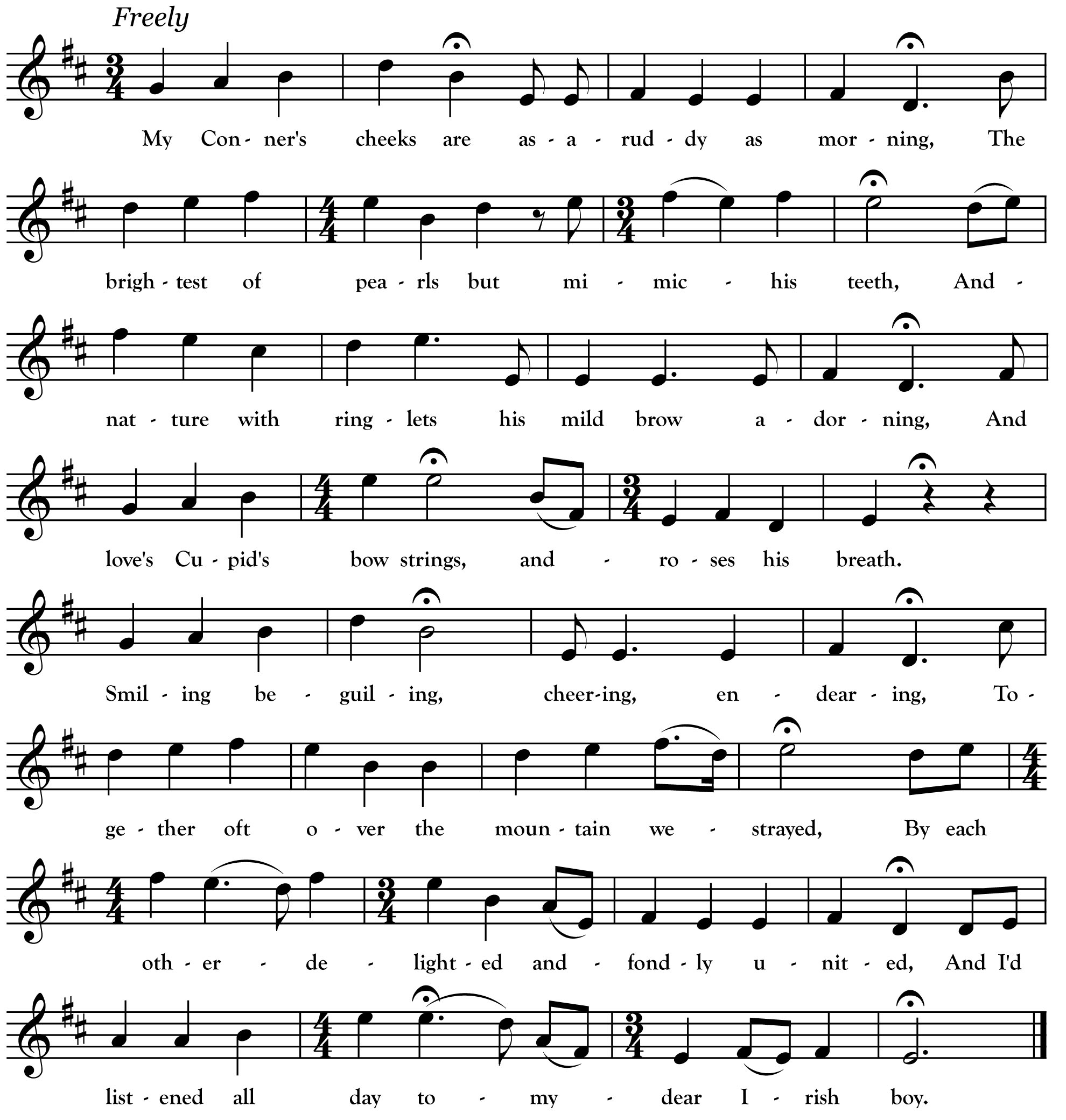
This version of the well-travelled traditional song “Caroline of Edinburgh Town” was sung by Minnesota singer Michael C. Dean and printed in Dean’s 1922 songster The Flying Cloud. Franz Rickaby transcribed the above melody from Dean’s singing in 1923 at Dean’s home in Virginia, Minnesota. Dean told Rickaby that his Irish immigrant mother Mary McMahon Dean used to sing the grim (but beautiful) song to him as a lullaby. This song was one of fifteen transcriptions Rickaby made from Dean’s singing that didn’t get published in Rickaby’s Ballads and Songs of the Shanty-Boy. I was able to access it via copies of Rickaby’s song notebooks held by the Mills Music Library at the University of Wisconsin in Madison. Unfortunately, unlike other songs of Dean’s, “Caroline” was not recorded when Robert Winslow Gordon made a series of wax cylinders of Dean’s singing in 1924 so we don’t know if his misspelling of “Edinburgh” was any indication of his pronunciation of the name of Scotland’s capital city.

I learned Dean’s melody and text in 2008 and sang it for the Minnesota Heritage Songbook project – a collection of old songs once sung in Minnesota. That recording (along with the full songbook) is available online at http://mnheritagesongbook.net.

My wife Norah Rendell sings this version as well and she even arranged it and recorded it with her band The Outside Track for their album “Curious Things Given Wings.” Much to my delight, Norah has also taught this Minnesota-sourced song to students at the Center for Irish Music.

07 Apr

St. Patrick’s Day

St. Patrick's Day

Come all of ye true sons of Erin,
Come listen awhile unto me,
You’ll find I’m a poor worn out creature,
Condoling here under a tree.
While the heart from my bosom was torn,
The truth unto you I’ll declare,
Young James was the flower of this island,
And he’s left me in grief and despair.

When first I beheld that young hero,
The hills and the valleys were green,
And the leaves they were all in full blossom,
Most beautiful there to be seen.
As she sat in her lone shady bower,
Those charming sweet notes she did play,
And the blackbird and thrush joined in chorus,
With her on St. Patrick’s Day.

Now my friends and my parents consulted,
And they found l was so well inclined,
False stories they told to my true love,
To banish me out of his mind.
But all that they said was a folly,
Every morning and evening I’ll pray,
I’m in hopes for to meet him with pleasure,
Once more on St. Patrick’s Day.

Now young James is the flower of this island,
The same I will never deny,
And the beautiful words that he told me,
I’ll never forget ‘til I’ll die.
But now he is crossing the ocean,
Every morning and evening I’ll pray,
I’m in hopes for to meet him with pleasure,
Once more on St. Patrick’s Day.

_____________

The Avalon Penninsula, on the rocky southeast coast of the remote Canadian island of Newfoundland, attracted a high concentration of Irish families as far back as the 1700s. Many Irish Newfoundlanders have roots specifically in the southeast of Ireland and, to this day, local accents are reminiscent of the Waterford Irish accent. (I highly recommend RTÉ’s incredible documentary The Forgotten Irish which includes footage from Avalon communities including several singers and is available free online.)

MacEdward Leach was the first song collector to bring recording equipment to Newfoundland. The recordings he made in small fishing communities are a treasure trove of beautiful songs. The above song was sung for Leach in 1951 by Cyril O’Brien of Trepassey, a small village on the Avalon. You can here the first verse of the Cyril O’Brien recording here (scroll down if you don’t see it right away).

Norah Rendell, Randy Gosa and I arranged an accompanied version of this song for Norah’s new album Spinning Yarns (officially launched this month). We based it on a snippet of Leach’s recording of this song and his transcribed text which, along with hundreds of other gems, is available online through the Memorial University of Newfoundland. The text above is Norah’s adaptation of O’Brien’s version and I made the transcription based on the Leach/O’Brien recording.

FUN ST. PATRICK’S DAY FACT: Due to its highly Irish population, Newfoundland is one of the only places outside of Ireland where St. Patrick’s Day is a public holiday!

25 Feb

Ye Noble Big Pine Tree

‘Twas on a cold and frosty morning
When the sunshine was adorning
The boughs of ev’ry lofty pine,
Making them in radiance shine.

Through the forest lone I wandered
Where a little brook meandered,
Gurgling o’er the rocks below,
Wading deep through ice and snow.

On its banks and right before me
Stood a pine in stately glory.
The forest king he seemed to be.
He was a noble Big Pine Tree.

I gazed upon his form gigantic.
Thoughts ran through my head romantic.
These were my musings as I stood
And viewed that monarch of the wood.

“For ages you have towered proudly.
The birds have praised you long and loudly.
The squirrels have chattered praise to thee,
O ye noble Big Pine Tree.

“When the lumberjacks first spy you,
They’ll step up to you and eye you.
With saw and axe they’ll lay you down
On the cold snow-covered ground.

“Your fall will sound like distant thunder,
And fill the birds and squirrels with wonder.
The snow thy winding-sheet will be,
O ye noble Big Pine Tree.

“Were you punky, were you hollow,
You had been a lucky fellow;
Then they would have let you be,
O ye noble Big Pine Tree.

“But seeing you’re so sound and healthy,
You’ll make some lumberman more wealthy.
There’s scads of wealth concealed in thee,
O ye noble Big Pine Tree.

“They will measure, top, and butt you.
Into saw-logs they will cut you.
The woodsman’s chains will fetter thee,
O ye noble Big Pine Tree.

“When your branches cease to quiver,
They will haul you to the river,
And down the roll-ways roll you in
Where you’ll have to sink or swim.

“In spring the agile river-driver
Will pick and punch you down the river.
There’ll be little rest for thee,
O ye noble Big Pine Tree.

“Up the mill-slide they will draw you.
Into lumber they will saw you.
Then they’ll put you in a pile,
Where they’ll let you rest awhile.

“In spring, when gentle showers are falling,
And the toads and birds are squalling,
They will take and raft you in
Where once more you’ll have to swim.

“Over dams and falls they’ll take you,
Where the rocks will tear and break you,
You’ll reach the Mississippi’s breast
Before they’ll let you have a rest.

“Then they’ll sell you to some farmer
To keep his wife and children warmer.
With his team he’ll haul you home
To the prairie drear and lone.

“Into a prairie house he’ll make you,
Where the prairie winds will shake you.
There’ll be little rest for thee,
O ye noble Big Pine Tree.

“The prairie winds will sing around you.
The hail and sleet and snow will pound you,
And shake and wear and bleach your bones
On the prairie drear and lone.

“Then the prairie fires will burn you.
Into ashes they will turn you.
That will be the end of thee,
O ye noble Big Pine Tree.”

_______________________

In the early 1920s, the above song text was sent in to collector Franz Rickaby (then English professor at UND in Grand Forks, North Dakota) by the song’s writer, Billy “Shan T. Boy” Allen of Wausau, Wisconsin. Allen, a 2nd-generation Irish-Canadian from New Brunswick, fed the northwoods song tradition of the Upper Midwest by composing new ballads based on old song types and repurposing old melodies for stories about his work as a lumberman. His song “The Banks of the Little Eau Pleine” became quite popular in the lumbercamps across the northwoods region.

Rickaby was unsure if “Ye Noble Big Pine Tree” entered tradition at all. However, I found a reference to it in an article about life in northern Minnesota logging camps written by J.C. “Buzz” Ryan:

During the winter of 1918-1919 in a camp north of Mizpah, Patty McLaughlin, a witty Irishman from Northome who could play the violin and loved to sing, would go into the bunkhouse on Sundays and some evenings and would play and sing and get the boys singing with him. He knew all the old songs and sang them very well. However it was “The Banks of the Little Eau Plaine,” “Ye Noble Big Pine Tree” and “The Foreman Young Monroe” that the boys liked the best.

I did some census research on Patty McLaughlin and discovered that he, like Allen (and many others), was also a 2nd-generation Irish-Canadian from New Brunswick who followed lumbering jobs to the St. Croix Valley region. It’s possible that the two men even met eachother and swapped songs in the Wisconsin woods. McLaughlin was a foreman in a camp near Hayward, WI in 1900 (according to the 1900 US Federal Census). Unlike Allen, who stayed in the Wausau area, McLaughlin followed his employment further north to the woods north of my hometown of Bemidji, MN.

Allen sang Rickaby a melody he said came from the song “Will the Weaver.” I heard a recording of Catskills singer Walter Wormuth doing “Bill the Weaver” and preferred it so I took the liberty of swapping it in for my own version above.