
Ye Noble Big Pine Tree
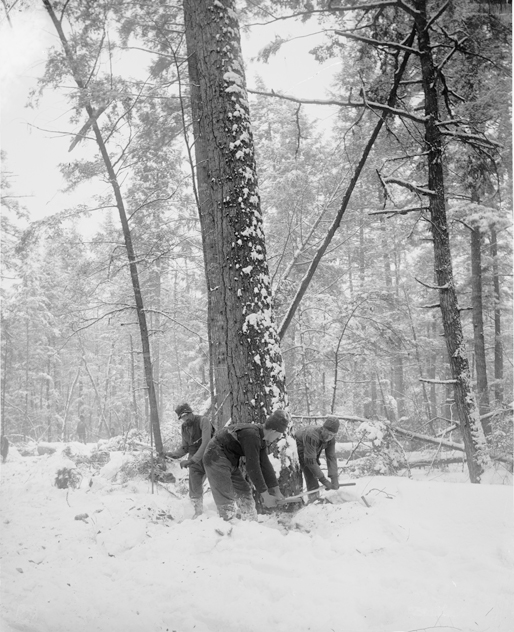

‘Twas on a cold and frosty morning
When the sunshine was adorning
The boughs of ev’ry lofty pine,
Making them in radiance shine.
Through the forest lone I wandered
Where a little brook meandered,
Gurgling o’er the rocks below,
Wading deep through ice and snow.
On its banks and right before me
Stood a pine in stately glory.
The forest king he seemed to be.
He was a noble Big Pine Tree.
I gazed upon his form gigantic.
Thoughts ran through my head romantic.
These were my musings as I stood
And viewed that monarch of the wood.
“For ages you have towered proudly.
The birds have praised you long and loudly.
The squirrels have chattered praise to thee,
O ye noble Big Pine Tree.
“When the lumberjacks first spy you,
They’ll step up to you and eye you.
With saw and axe they’ll lay you down
On the cold snow-covered ground.
“Your fall will sound like distant thunder,
And fill the birds and squirrels with wonder.
The snow thy winding-sheet will be,
O ye noble Big Pine Tree.
“Were you punky, were you hollow,
You had been a lucky fellow;
Then they would have let you be,
O ye noble Big Pine Tree.
“But seeing you’re so sound and healthy,
You’ll make some lumberman more wealthy.
There’s scads of wealth concealed in thee,
O ye noble Big Pine Tree.
“They will measure, top, and butt you.
Into saw-logs they will cut you.
The woodsman’s chains will fetter thee,
O ye noble Big Pine Tree.
“When your branches cease to quiver,
They will haul you to the river,
And down the roll-ways roll you in
Where you’ll have to sink or swim.
“In spring the agile river-driver
Will pick and punch you down the river.
There’ll be little rest for thee,
O ye noble Big Pine Tree.
“Up the mill-slide they will draw you.
Into lumber they will saw you.
Then they’ll put you in a pile,
Where they’ll let you rest awhile.
“In spring, when gentle showers are falling,
And the toads and birds are squalling,
They will take and raft you in
Where once more you’ll have to swim.
“Over dams and falls they’ll take you,
Where the rocks will tear and break you,
You’ll reach the Mississippi’s breast
Before they’ll let you have a rest.
“Then they’ll sell you to some farmer
To keep his wife and children warmer.
With his team he’ll haul you home
To the prairie drear and lone.
“Into a prairie house he’ll make you,
Where the prairie winds will shake you.
There’ll be little rest for thee,
O ye noble Big Pine Tree.
“The prairie winds will sing around you.
The hail and sleet and snow will pound you,
And shake and wear and bleach your bones
On the prairie drear and lone.
“Then the prairie fires will burn you.
Into ashes they will turn you.
That will be the end of thee,
O ye noble Big Pine Tree.”
_______________________
In the early 1920s, the above song text was sent in to collector Franz Rickaby (then English professor at UND in Grand Forks, North Dakota) by the song’s writer, Billy “Shan T. Boy” Allen of Wausau, Wisconsin. Allen, a 2nd-generation Irish-Canadian from New Brunswick, fed the northwoods song tradition of the Upper Midwest by composing new ballads based on old song types and repurposing old melodies for stories about his work as a lumberman. His song “The Banks of the Little Eau Pleine” became quite popular in the lumbercamps across the northwoods region.
Rickaby was unsure if “Ye Noble Big Pine Tree” entered tradition at all. However, I found a reference to it in an article about life in northern Minnesota logging camps written by J.C. “Buzz” Ryan:
During the winter of 1918-1919 in a camp north of Mizpah, Patty McLaughlin, a witty Irishman from Northome who could play the violin and loved to sing, would go into the bunkhouse on Sundays and some evenings and would play and sing and get the boys singing with him. He knew all the old songs and sang them very well. However it was “The Banks of the Little Eau Plaine,” “Ye Noble Big Pine Tree” and “The Foreman Young Monroe” that the boys liked the best.
I did some census research on Patty McLaughlin and discovered that he, like Allen (and many others), was also a 2nd-generation Irish-Canadian from New Brunswick who followed lumbering jobs to the St. Croix Valley region. It’s possible that the two men even met eachother and swapped songs in the Wisconsin woods. McLaughlin was a foreman in a camp near Hayward, WI in 1900 (according to the 1900 US Federal Census). Unlike Allen, who stayed in the Wausau area, McLaughlin followed his employment further north to the woods north of my hometown of Bemidji, MN.
Allen sang Rickaby a melody he said came from the song “Will the Weaver.” I heard a recording of Catskills singer Walter Wormuth doing “Bill the Weaver” and preferred it so I took the liberty of swapping it in for my own version above.

![PrintMusic! 2004 - [Ye Rambling Boys of Pleasure]](http://www.evergreentrad.com/wp-content/uploads/2014/12/You-Rambling-Boys-of-Pleasure.jpg)