02 Nov

The Hunter’s Death


rwp_a003-hunters-death

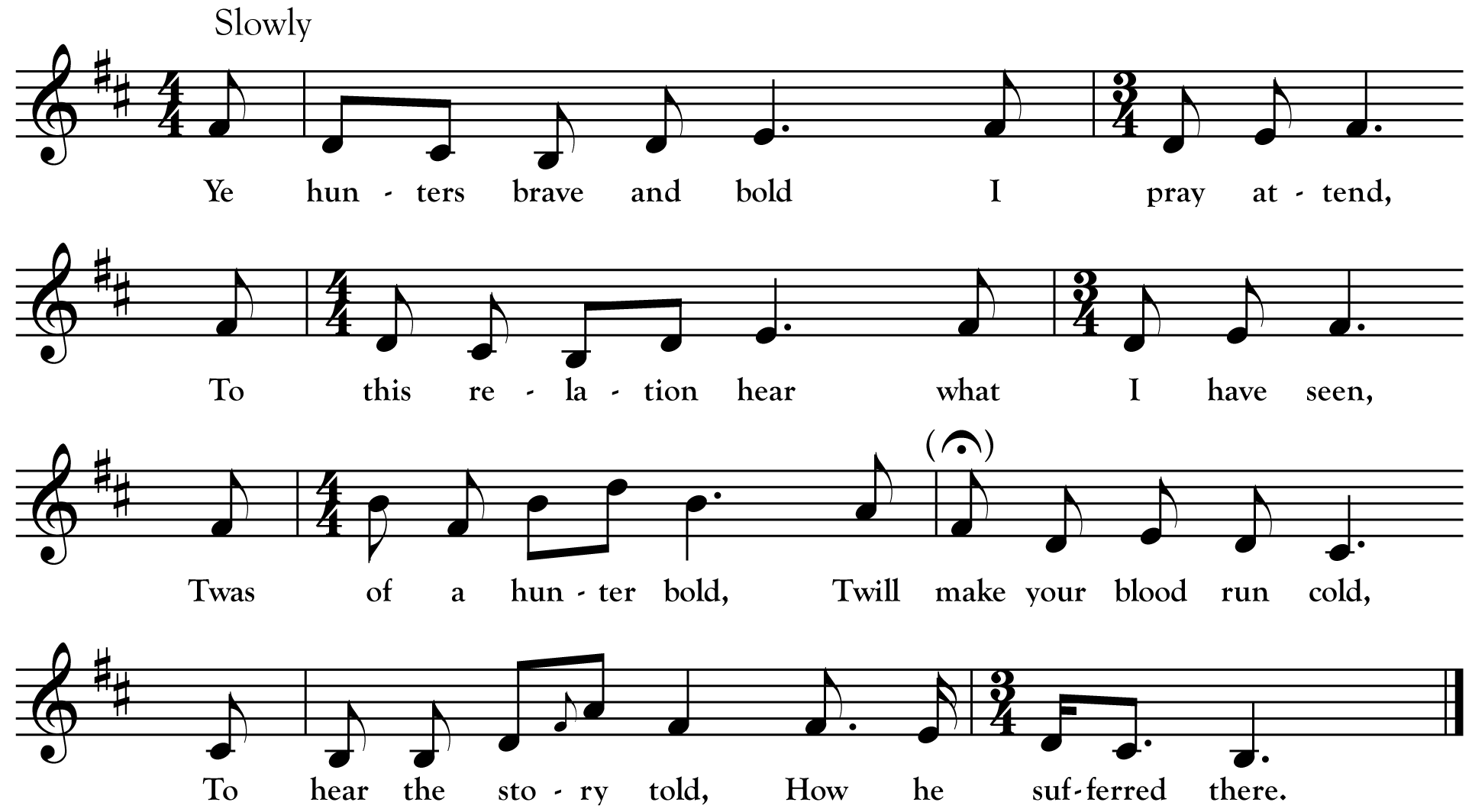
Ye hunters brave and bold I pray attend
To this relation hear what I have seen
’Twas of a hunter bold
’Twill make your blood run cold
To hear the story told
How he suffered there.

To hunt when he was young was his delight
And when to manhood grown his favorite
To hunt the fallow deer
The roe buck and the bear
The turkey coon and hair
With smaller game.

As people settled round on hill and dale
No ven’son to be found his hunting failed
He went in forty nine
Towards the northern line
It was his hull design
To hunt the grove.

And now comes on the day that was his last
Old Boris [Boreas?] blew away an awful blast
It both rain hale and snow
The stormy winds did blow
They chilled his nature so
Poor man was lost.

All in the drifting snow laid himself down
No further could he go there he was found
His powder so complete
Was strewed from head to feet
That the vermin might not eat
His body there.

You’d wish to know his name and where he’s from
And of what stock he came and where he’s born
He’s of as noble a race
As any in the place
His name ’twas John Lomace
Born in Westfield.

—————

We stay on the hunting theme this month with a wonderfully obscure and fascinating song from the repertoire of Reuben W. Phillips of Akeley, Minnesota. “The Hunter’s Death” was one of 22 handwritten song texts Phillips sent to collector Robert W. Gordon in March 1924. Upon receiving the songs from Phillips, Gordon was drawn to “The Hunter’s Death” in particular for its “peculiar stanza form.” He published the song’s text in the August 20, 1924 edition of his pulp magazine column “Old Songs That Men Have Sung” calling it “a curious little song, particularly in its use of the short but effective line without rime at the end of each stanza.” Soon after, Gordon hauled his Edison cylinder recording machine from Berkeley, California to Akeley to record Phillips singing the song himself. Gordon remembered the song several years later when fellow song-catcher Joanna Colcord sent him another song collected in Vermont called “The Damsel’s Tragedy” with much the same form:

Indulgent parents dear I pray attend
To this relation hear which I have penned
A deeper tragedy
You never knew, for why?
A mother’s cruelty
Ruined her son.

Given that both songs can be traced to Vermont, “The Damsel’s Tragedy” may have been the template for “The Hunter’s Death.”

Phillips told Gordon that “The Hunter’s Death” was composed in northern New York around 1849 in the vicinity of Hopkinton where Phillips himself was born. It was based on an actual man, John Lomace, who lived in the area. Westfield, Vermont is about 100 miles east of Hopkinton on the other side of Lake Champlain. Both towns are quite near the “northern line” where one crosses into Canada.

Last month, I launched the Minnesota Folksong Challenge. This is your chance to get involved in reviving the folksong heritage of Minnesota! Learn a song from the Minnesota Folksong Collection and post a video on Youtube of yourself singing it. Send me the link and I’ll add you to the growing collection of videos here! St. Paul singer John Wenstrom took the Challenge and learned “The Hunter’s Death.” You can see John’s video at the Minnesota Folksong Collection site along with the new video of the Lost Forty doing our version of this song.

This activity is made possible by the voters of Minnesota through a grant from the Minnesota State Arts Board, thanks to a legislative appropriation from the arts and cultural heritage fund.

legacy_logo_bw msab_logo_bw

03 Oct

Vandiemens Land (Revisited)

mcd_a016-vandiemens-land

Come, all you lads of pleasure and rambling boys beware,
Whenever you go hunting with your hounds, your gun and snare,
Whenever you go a-hunting with the valleys at your command,
Think of the tedious journey, boys, going to Vandiemens Land.

There was Joe Brown from Nottingham, Jack Williams and Jack Jones,
They were three as jolly fellows, so well their country knows;
They were taken one night near the bay, all with their gun in hand,
And for fourteen years transported unto Vandiemens Land.

There was a girl from Nottingham, Sally Simons was her name,
For seven years transported for carrying on the game;
Our Captain bought her freedom and he married her off hand,
She gave us good usage going to Vandiemens Land.

The landing port we went to was on a foreign shore,
The planters they surrounded us, full a score or more,
They yoked us up like horses and sold us out off hand,
And they hitched us to the plow, me boys, to plow Vandiemens Land.

The houses that they built for us was made of sods and clay,
The beds we had to sleep on were made of rotten hay;
Oh, rotten hay for beds, me boys, and slumber if you can,
Oh, they gave us the very worst usage while on Vandiemens Land,

Last night as I lay down to sleep I had a pleasant dream,
I dreamt I was back in Ireland, down by a purling stream,
With my Irish girl beside me and her at my command,
But when I awoke my heart was broke, off on Vandiemens Land.

————–
We return this month to another song from the repertoire of Irish-Minnesotan singer Michael C. Dean that I wrote about first in July 2013. You can now hear the 1924 field recording of Dean singing “Vandiemens Land” at the Minnesota Folksong Collection site.

It is fascinating to imagine what this song’s story of convicted poachers deported to Tasmania (Van Diemen’s Land) might have meant to Dean – himself an avid hunter. When Dean’s parents left Ireland around 1840, illegal hunting was still punishable by “transportation.” It was also sometimes a crime of necessity during the frequent food shortages of those years. In Minnesota, 50 years later, Dean enjoyed frequent hunting and fishing excursions much the same way modern Minnesotans do.

Dean lived in Pine County, Minnesota from about 1885 through 1917 and did much hunting and fishing each fall during those years. His excursions were often mentioned in the colorfully-written local section of the Pine County Pioneer:

“Mike Dean and party have returned from their hunting and fishing expedition up to Grindstone Lake. Mike doesn’t tell any big fish stories but says they had an immense time and when asked if they were successful, merely winks.” (Oct. 14, 1887)

“M.C. Dean, J.J. Brennan, A. Anderson and Axel Hanson went on a hunting expedition on Tuesday and expected to bring back some game, but lo! Not even a frog did they get.” (August 30, 1889)

The lure of the wilds caught Mike Dean and he skidooed north over the N. P. [Northern Pacific Railroad] early Wednesday morning. The hunting “yarns” spun by returning sports got on Mike’s nerves. He took along a small arsenal. Had he went south, one would be led to believe that he was heading for Mexico to annihilate Huerta and his ilk [Victoriano Huerta was a major player in the ongoing Mexican Revolution that year]. (Nov. 21, 1913)

Apparently Dean wasn’t much for telling “fish stories” but I expect his singing of “Vandiemens Land” may have been popular with his hunting friends.

legacy_logo_bw msab_logo_bw

 This activity is made possible by the voters of Minnesota through a grant from the Minnesota State Arts Board, thanks to a legislative appropriation from the arts and cultural heritage fund.

01 Sep

Lost on the Lady Elgin (revisited)

MCD_A026 Lost on the Lady Elgin

Up from the poor man’s cottage, forth from the mansion door,
Sweeping across the water and echoing along the shore,
Caught by the morning breezes, borne on the evening gale,
Came at the dawn of morning a sad and solemn wail.

Refrain—
Lost on the Lady Elgin, sleeping to wake no more,
Numbering in death five hundred that failed to reach the shore.

Sad was the wail of children, weeping for parents gone,
Children that slept at evening, orphans woke at morn;
Sisters for brothers weeping, husbands for missing wives,
These were the ties that were severed by those five hundred lives.

Staunch was the noble steamer, precious the freight she bore,
Gaily they loosed their cables a few short hours before,
Proudly she swept our harbor, joyfully rang the bell,
Little they thought ere morning it would peal so sad a knell.

——————————-

We return this month to the song “Lost on the Lady Elgin” from the repertoire of Minnesota singer Michael Dean. The song depicts the outpouring of grief that followed the tragic sinking of the side-wheel passenger steamer Lady Elgin in Lake Michigan 156 years ago in September 1860. The ship’s loss struck a particularly painful blow to the Irish community of Milwaukee’s Third Ward as many of the doomed passengers hailed from that area. The Lost Forty was in Milwaukee ourselves last month for their annual Irish Fest and we videotaped our version of the song in the historic Third Ward on the banks of Lake Michigan.

Michael Dean’s older brother James came to Milwaukee around 1865 and lived in the Seventh Ward—just north of the Third. James Dean served a long career as conductor for the Milwaukee Railroad. It is possible that Michael learned the song during a trip to visit his brother though the song also travelled all around the US and Canada and was popular throughout the Great Lakes region especially.

Since I began singing “The Lady Elgin” I have met people who have stories about family members singing the song and, in the case of one audience member I met at the Minnesota Irish Fair last year, an ancestor who was lost in the wreck itself.